Thursday, January 14, 2021

It was a great day for America

I want to talk about Jan 6th, 2021 and the storming of the capitol building in Washington.   But I'm going to start by telling you about my back pain.

I'm on the older side of being a young person, and as with many people, I wake up with a stiff back frequently.  I have to be careful in the morning not to push it too hard (bend deeply, twisting fast moves) lest I put it 'out'.  It's an annoyance and one I've grown used to.  But I don't do anything about it - I don't visit my doctor or a physiotherapist to address it, I just accept back pain and stiffness as a part of life.  I don't like it, but there you go - I've gotten used to it.

I was dealing with Trumpism the same way, I didn't like it, I knew it was wrong and damaging, but largely choose to ignore it versus tackling it head on. For what it's worth, I think there's a difference between conservative values traditionally embraced by US Republicans and Trumpism, he was an outlandish fringe and neither consistently conservative or stable.   Trumpism brought out the worst instincts and reactions in people like Cruz, McConnell and others with the lure of electability.

Life is funny though, anyone that plays the fool for too long, often becomes the fool.  You can't deny reality and expect no consequences, and so embracing the darker elements of his movement and instilling them to action for him was bound to turn out badly.  And it did on Jan 6th. 

Now, there are consequences.  Like the child that throws the tantrum, or the drinking binge that lands you in jail, this too crossed the line - that line that was pushed and stretched oh so very far over the past 5 years as society's norms and expectations were trodden over for attention grabbing stunts.   But it almost needed to happen, for the accountability due to this fool to actually occur.  If he'd gone quietly into the night, and behaved reasonably, then we'd have new thresholds for abuse of power in government.  This way the clarity around the idea he should never hold elected office again is in many people's minds, his foes and former supporters alike.  He crossed the line.   And the impeachment, the accountability isn't just about the Capitol, its about the last 4 years all-told, the sum of idiocy that the man brought down on the good name of his country for vanity, power, money or just attention.  I don't understand his 'why', and it'll be a feature of literature for years to come I suspect.

When I put my back out and am hobbled, I'm going to get medical attention and have it fixed.  Jan 6th was that day for America, the long needed final straw and thank goodness it finally arrived as the motivation for long needed action to happen.  It was a great day for America.


Thursday, December 31, 2020

Ladies and Gentlemen, Start your Engines

In Formula One auto racing the cars start from a grid layout while standing still, and as you can imagine it gets REALLY LOUD just before the final light turns green and all the racers set off.  Mayhem ensues.  There are full throttle cars manoeuvring, side-swiping (and avoiding side-swiping) and as a result crashing, and careening off one another.  All are jockeying for position.  It's a mess, performed under the guise of sports entertainment.  But it isn't unexpected.  It's a mess as you have all the cars and teams executing starting strategies differently.  

An orchestrated mess. And it reminds me of the economy.

Each car/team represents a market segment (the auto industry, natural resources, big-tech, and more -  insert the industry you work in here) and more often that not, they want consumers to do different things and act in different ways.  As a result they manoeuvre, side-swipe and react to competitive and market pressures to avoid side-swiping their target markets and as a result crash, and careen off one another.  All are jockeying for position.  

Governments provide the rules and paths and as there is rarely a holistic master plan, the rules usually don't account for other industries' situations well - which is why we have industrial pollution loopholes, and radio spectrum overlap (turn off your cell phones now, we're coming in for landing) amongst two overly simple examples.  Special interest groups emerge to push for their their aims first above others - drilling in wildlife reserve, or funding for charter schools.  Too many vested interests to list.

This is life as we were used to it.  Chaotic, and hard to track.  We have economists who try to make sense of it all and even they don't all agree on everything going on. More debt, less debt, high interest rates to stimulate growth, or lower to curb inflationary worries.  Clear as mud, right ?

Now, let's revisit the Formula One starting grid metaphor for a moment.  The real difference between the economy normally and this car racing phenomena is that standing start, as the economy is ongoing, perpetual and probably tracks closer to the cycle of lap times metaphorically than a start/stop moment in time.  

But.  (Go back to the previous paragraph and note the word "normal").

Our economy has been largely standing still due to the virus.  We are asking ourselves questions like - 'will life ever go back to the way it was?' Vast numbers of unemployed people, massive government stimulus packages put us in a tenuous position.

Truth is that this all will require strong economic growth engines and re-energizing economies for governments to re-charge their coffers.  My crystal ball says we are about to enter an economic period that parallels a 1950's era western post-war rebuilding effort.  And the beneficiaries of this will be those well positioned to get off the starting line quickly.  Those organizations that have fast plans to take the lead, and go green, go sustainable, and capture new customers.  The survivors of the long winter in commercial real-estate, aviation and tourism industries are poised for fantastic growth.  So, sell that Zoom stock, because ladies and gentlemen, with multiple vaccines now beginning to be administered, it's time to start your engines.


Wednesday, December 30, 2020

A New Year Beckons

 A new year denotes change, and that is desperately needed.  Understatement accomplished, let's move on.

Beyond the news cycle and constant covid updates, we are back to the turning to the new year, and all the hope, idealism and more that this always means.  We will make resolutions with the best of intentions (or not) drunk and sober.  We will pledge to lose weight, fall in love, fall into shape, or fall into a new job, relationship, or situation. But the reality of this new year shouldn't be lost on us.  Too often life complicates our ability to achieve our desires - the job was hectic, the schedule allowed us no time, or we weren't financially in the right place to save for that big dream.  Of course this year is different, we will still be looking for new work, or stuck in our home offices with endless meetings.  

So how to make your new year resolutions come true ?  

Make a plan.  It's honest to goodness that easy.

The resolution is the "what", and while it's always fun to dream up new "whats", the truth is that was never going to be challenging bit.  The hard part is the "how".

I'm a personal fan of this structure - 'Objectives, Strategies and Actions'.  It allows for clarity of direction, a pathway that can be changed, and the opportunity to make some mistakes or mis-steps.  That last part of pretty important, as I need the ability to fall off the wagon without throwing away the whole thing.    Let's break this down:

Objective:  that's your resolution itself.  Lose 10 lbs, stop eating sugar (my own), meet new people, or learn latin...whatever you want to do.

Strategy:  This is the macro-plan.  Let me illustrate - I'll remove refined sugar from my daily intake by understanding what it's contained in, and find substitutes for those things.  I know directionally this will mean prepping more food I'll eat later, and avoiding some favorite temptations.   Your strategy might be to schedule time for the gym, or a nite out, or give/toss the bottles you have in the house to a friend.

Actions:  This is the day to day stuff we will each do that aligns to our strategy.  So when I go shopping for food (an action), I won't buy cookies or ice-cream. Another action would be to prep some snacks as I'm prone to grazing while I work.  Your actions would also support your strategy, as applicable.  What happens if I cave in and eat sugar-coated sugar treats one-day ?  Well the action that may have prevented it didn't work, and I understand that, and don't try that same action and expect a different result.  The plan remains intact, and I learn from this and move on.

That's my plan, and I've given some thought to the how.

What's yours? 


Saturday, May 9, 2020

Balance in Societies - Weapons v Freedoms

Freedom is perhaps the most misconstrued word in the english language.

Freedom to me can be the ability to do without something, and to you it might be the capacity to have the very same thing.  We can both scream and claim our need (and rights?) for freedom on the very same topic, and be 180 degrees apart on a subject, black and white, right and wrong.

Freedom means choice, or not being controlled in the sense we hear it used frequently in the debate over weapons in society.  But it doesn't infer, directly support, anecdotally mean or even imply one choice over the other, it is by definition the nature of having choice. Nothing more.

The history of our political gatherings, both as tribes and nations has meant most have been fraught at some point with periods of tyranny and oppression, with one person or a small group trying to impose their will on a larger group.  (It says much about about us that this political pattern keeps repeating, and we don't seem to learn from it).  In this context, freedom is often embraced as the ideal of throwing off the yoke of oppression to be able to rule ourselves, and hence the first and second contexts of the word "freedom" are often mixed up, and used interchangeably when discussing freedoms around weapons.

A modern open society, built on a framework of laws, created by publicly accountable, elected individuals who serve at the public's request are tasked with maintaining order.  While there is often some element of crime or disorder in a society, by and large its considered manageable enough that we still defer to the mandate of society to enforce order, while doing smaller, personally-motivated things (like locking the car door in a public place).  The consequence of that is that citizens in many places have the ability to have the freedom (read: choice) to not own weapons that would otherwise be needed to maintain order.  They have outsourced that to society at large that they live within. 

This is where it gets interesting I think.  Where that faith in one's political structures doesn't exist, where I as a citizen don't believe that order today and tomorrow can be maintained in the political structures we make a choice. In that situation I may decide that the same freedoms (read: choice) inferred on me in that same society allow me to second guess society's ability to manager order, and hence I'll arm myself with weaponry to provide a degree of personal confidence that order can be maintained.  The implication is that if society can't manage order, then I can still look after myself.  They are 'an insurance policy' in that sense, and driven from insecurities.

Both of these perspectives are understandable as human responses,  and both are arguably legitimate use of freedom, but neither create more or less freedom, or are done in the name of freedom.  A weapon is a tool, designed to make a task easier to accomplish, in the same way a shovel assists us should be we need to create a hole in the dirt.

But here's the challenge with the pro-weapon argument I think.   Dynamite is also a tool that might be used to create a hole in the dirt.   It has specific use-cases (mining), but isn't something most of us might use to plant a rose bush in our garden.  That's because it has the capacity to create significantly more damage/impact that a another tool for the same task might make. So the utility element of the tool needs to be weighed against both it's effectiveness to perform the function and its' potential to cause other damage, hence there are laws in societies around the personal use of household dynamite.  The same rules apply to gun ownership in many cases, for exactly the same rationale, especially 'assault weaponry'.  My need to hunt a deer doesn't extend to dealing with a special forces attack squad of deer.  The tools' capacity for harm in a society is outweighed by its utility to create unnecessary harm in society.

Freedom (and the need for it) as an excuse to own personal weapons that could cause significant negative impact isn't valid.  The argument itself and intermingling of the concepts of freedom are also disingenuous and transparently incorrect.  While those are true statements,  there is some context here.  Where one's society is at risk, and effective governance isn't in place - think about Syria today, or the wild west of North America 150 years back - then the risk may warrant the response.  But the gun control argument isn't being held in those situations, its being held with your neighbour today. Guns don't equal freedom, and never have.


Monday, April 27, 2020

Childhood's End

I've borrowed the name from one of my top three favourite books, an Arthur Clarke jewel that outlines a tremendous change in the world that forces everyone to re-assess every preconceived notion they have.

The idea is present in more than just fiction, historical dramas sometimes refer to this occurrence too - the time to grow up as a people, often forced and usually against our will. Change is always hard. In wartime or other great stresses on a society we are forced to very seriously address the situation we face.  These are events or times when we leave our childhood, our complacencies and innocence behind.  I think as time goes on, we're entering another of these with the virus. A time when we will separate into those that act on what's best for us all, vs. their own self interest.  As I wrote about recently, it's my opinion that the "me-centric self-centeredness" was one of the least desirable outcomes of the positive and plentiful times that we have lived in 'pre-virus'.  In that sense, the virus has addressed an imbalance in how we have viewed our own position vis a vis others and taken society's benefits for granted.

And now it's over.  Now we have seen literal life and death choices being made - despite our advances, technologies and connectedness.  And now we are seeing the world start to re-open, and some complainers argue it's not fast enough.  But let's at least be honest with ourselves - we can't go back, we can't reclaim our complacency.  We need to be a little smarter and more adult about our immediate future.

We are facing hard choices, defining choices, and it will result in a seriousness about our greater situations.  At least I hope it will.   Our willingness as a species to take advantage of one another over a dollar, or food, or water or a job should be reassessed.  We need to understand that we are a village, and have to be both independent in our communities (for enough ventilators, PPE, and health care services), and willing to help when those outside our communities that need it.  In hindsight, what if we had all pitched in and helped China contain and defeat this thing ?

Babies are self absorbed until they learn about others through communication and socialization.  We adults can no longer afford to be.

Sunday, March 22, 2020

It Takes a Village

Times are unprecedented to say the least.  We are all starting to feel that on a personal level.  It's rather alarming that some deaths in 'other places' and a week self isolated can change our world, but it seems to, when bound together with tangible fear for ourselves, each other and our way of life.

I'm going to suggest that this isn't all bad, in fact some aspects of it are a good thing.

Now, I'm either a very late Boomer, or an early Gen X'er, so understand that my perspective here is shaped by my age and the times I've lived through.  Your own perspective may well be different - that's cool, differences make for a richer mosaic. I'm not right, (and neither are you) we're just a couple voices.  The key I think is listening to the voices.

The stress our world is going through right now could well be a good thing, as we needed a big shock to get out us out of our "me-centric" complacency and attitudes, to reframe the idea we're a community (many in fact) and there's much mutual dependance.   Right now many of us are depending on the strangers that deliver food to our local stores, or provide media programming, or keep our intewebs working.  Chances are we don't actually know any of these folks.  But we're a community and so appreciate that they are working and risking to support us.   Normally we only see that in the police, firefighters and nurses, doctors and teachers, and don't imagine that your role or my role in society actually contributes, but it does.

Keep in mind, that in December or January or even February this year depending on where you live, these are the same strangers we cut off in traffic, or argued at online, or made disparaging comments about due to wage discussions, and the way their situations may have affected our own view of how the word treated us, treated me. "Why should teachers get paid so much...when I don't....they should all be fired."  We were pretty set in our ways, and the moves present in lots of places to elect divisive leadership that focused and leveraged our dissatisfaction with other groups and their perceived successes and ability to affect our lives, these reflected that.  Even today, conspiracy theories abound that the virus is being supported or 'done to us' in some nefarious plan.  Sigh.

Humans are social beings.  We look for inter-connections with others and have constructed our societies in this way.  In six to twelve months when the virus thing has shaken out,  it's my hope that we'll look at our connections to one another as the key, as our saving grace, and appreciate each other more.  If the virus kills off me-centricity, then that's one victim I won't mourn.


Sunday, February 9, 2020

Frustration

This emotion has always been my achilles heel.   Our friends at Mirriam Webster define it this way - a deep chronic sense or state of insecurity and dissatisfaction arising from unresolved problems or unfulfilled needs.  I suppose that like a lot of people I'm a problem solver, or if this was a job interview and I was asked about a strength/weakness, I'd offer that I'm someone that prefers to be  prone to action.  I don't like just letting issues or problems sit, I'd like to solve them and move on.  The critical element there being the move on part. Bleeding? Get a bandaid and get on with it, business issue? resolve it or agree you can live with it and move forward.  You get the idea.

The challenge here as I'm sure is obvious to all, is that some issues aren't solvable, or at least not easily, or in a manner that many can agree on.  Politics, religion, families and job situations all come to mind.  So what happens when an unresolved issue just percolates and sits like a festering sore ?

A picture is worth a thousand words as they say. That's how it eventually feels for me.

Not everyone is like this of course, some of us can see the bright side, the glass is half full, and want us all to be true to ourselves and vulnerable about the changes and challenges we face.   When personally faced with a high degree of frustration, and I start hearing that, reading it or being exposed to it in some (asinine) online posting, I personally feel like I'd like to share the explosion a little more closely with them.  Which is why frustration is such a pain in the you-know-what, as most of us have enough of our own, that we don't want someone else's too.

I've thought a lot about the topic over the years, and have tended to reflect a little on the less shareable elements - the insecurity and unresolved issues parts.  Sure, a 'type A' personality that likes a controlled outcome has probably been motivated in some way towards that behaviour.  Type A's (or high "D" in a DISC sense- look it up) aren't born that way, they've grown to want these outcomes due to circumstances in their upbringing or experience.  Which is ironic in many senses as families and jobs/work can be a huge source of frustration.  Our psyche's are self fulfilling ?  Maybe.

I don't have an answer to frustration, (which is also funny), but do have an awareness towards the triggers for me or root causes of it as I've grown older, and find myself actively steering away from these. I don't think that reflects personal growth so much as awareness, with the latter being the first necessary step towards dealing with any problem. 

I offer this for a few reasons - I wanted to vent a little today; and I wanted to offer to the casual onlooker that if you feel I'm ignoring you, its actually probably how I'm dealing with you.  Not always, but sometimes.  I imagine that might be frustrating for you now that you realize it.


Sunday, January 19, 2020

Mountains of the Moon - Trekking the Rwenzori's


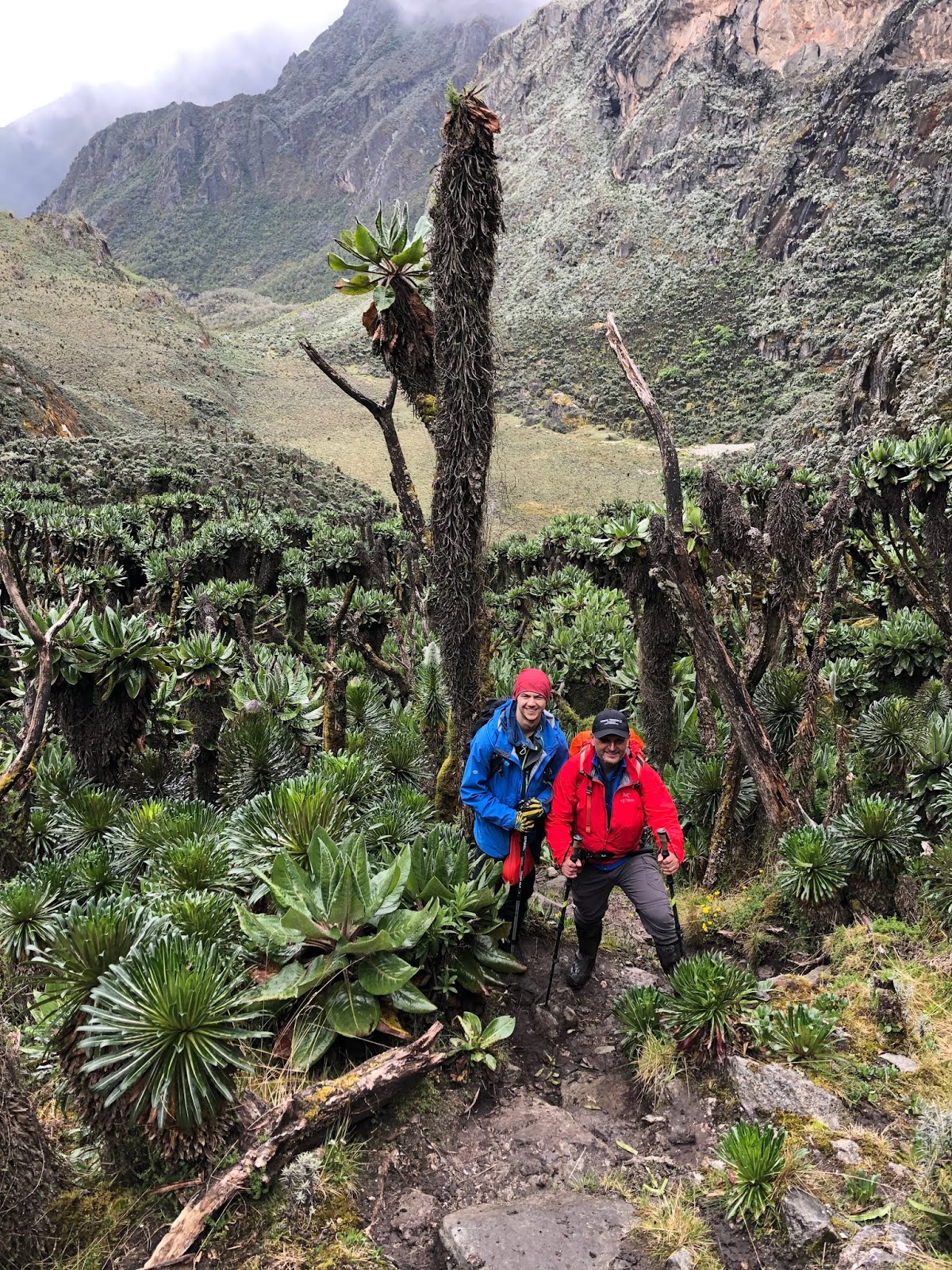
 We had set up ourselves for the trek to Mountains of the Moon. This “legendary” set of mountains were so named (as the story goes) by the Ancient Greek mathematician Ptolemy. That’s probably because they are clouded in cold and heat and weather through much of  every day, and more often only visible at night with moonlight, that reflected off of the top glaciers. At 5,000M+/15,000ft they are both high and inaccessible. They are Africa’s 3rd highest peaks (after Kilimanjaro and Mt. Kenya) but unlike these others, there are no crowds, in fact hundreds a year come here vs thousands a night on Kili. That was what drew us, the promise of unspoiled Africa, the remoteness and the chance to re-connect to an area we both really enjoyed.

Also unlike previous treks, we had arranged this Uganda adventure ourselves, John and I. John had found a very local guiding operation and they were our primary source of contact and information. We weren’t sure until the week or two prior if we’d be on our own or in a bigger group.

We got to Uganda’s capital Kampala, though never went in, electing instead to stay at Entebbe where the airport was on the northern shore of Lake Victoria. Partly as it was an hour plus each way and also as we were flying out again the next day to Kasese, as our trek starting point in western Uganda on a local Cessna operator called Aerolink and partly too as we had heard and researched little of note about Kampala. (big African congested city)

Our 3rd day of travel (still getting to the trek’s starting line, post long haul planes and thankfully a night in a nice bed) saw us fly from Entebbe to the area of Uganda bordering the DRC, where the runway was grass (read: a field) and the airport was a single room house. This was the western Uganda town of Kasese, where we would stay the night and meet fellow trekkers. We actually flew with Sebastiano, an Italian Coast Guard official from Genoa, who was easily identifiable on the flight from his mountain boots, which were too big to pack. Lovely gentleman.

Our briefing that night happened around 7pm with Moses Kasini, our Head Guide and Brian from Rwenzori Trekking. They outlined what to expect and who else would be going (a group of 10 Americans who were driving in from Kampala). Easy all around, we were set to depart at 7am the following morning to begin.

On day one we met the whole group, a party of 13 in total with us, including 10 Americans organized by “CrewTreks”, an airline flight crew adventure travel company, whose founder Marek was joining as well. Interestingly, this was Marek’s 2nd time up the mountains, so he was both knowledgeable and helpful. John and I and Sebastiano from Genoa, rounded out the 13. The plan as laid out early was for 5 of the crew-treks folks to go for the summit as well as we three. I was initially a little concerned as there were only 2 of the US group in their early 30’s while everyone else was 40-70+. I didn’t want John to feel isolated. It was a mirror image of the Everest trek we had done a couple years earlier in that sense.

We got our gear together and went from the hotel, piled into multiple vehicles and went to the trekking company base camp where we had another briefing that was largely the same as the previous nights', though we met all 4 guides and Peter Hunwick the Aussie owner of the company. Extra mountaineering gear was stored at top camp (good, we didn't have to carry it up) and we borrowed rubber boots for day 2 as it was supposed to be very boggy. *** (this should have been a bit more or a red -alert in hindsight). They also provided umbrellas which was an omen for day 1 it turned out in a weather and trail sense.

 We got a ride again to the trail head and set off as 43 all together. 13 trekkers, 4 guides and 26 porters. big group. After a fairly easy 2km set of ups and downs, we came to the Park gates and Ranger station where we registered (and paid entrance fees if not already done). The big feature that rather defined the day was the rain that began 1 km into the hike. Hard, big rain. We made some outerwear changes on the fly. We began in the rainforest at 1750M.

Two things became apparent at this point - our plan to bring big canoe-style water backpacks that are 100% waterproof was a smart idea, and secondly that the best waterproof clothing gear doesn’t breathe in 100% humidity and rain. Not when ascending steeply (30-45 degrees in spots) I for one was soaked to the skin from the hours of hard rain, and extreme steepness and poor footing. A muddy rocky trail after 4+ hours of hard rain becomes a river as we have learned in Algonquin hikes in days gone by. We were thoroughly wet, inside and out. Luckily it was warm.

The climb (about 800M) was challenging and slow, on par with a really hard workout. Some steps were super high and everyone lost footing at least once. But the walk took us up above the rainforest, and into the bamboo zone and then above it into the “heather zone”. Plants changed, it’s became less dense, cooler and the flowers were pretty spectacular. It’s also notable for the other people we saw - which was none.  The first day saw us move through four of five zones we ascended through, each a different bio-sphere and fascinatingly beautiful.

To say we were hot, dirty and mud covered is an understatement arriving at Sina Camp. It was a welcome breath of civilization with huts with solar lights and a set of tables and benches. Situated between waterfalls it was gorgeous. We were at 2575 M up in the Rwenzori/ Congo rainforest and it was bug free (mostly) and lovely. The porters of course beat us here so tea and hot chocolate and biscuits were out as we set about attempting to dry our gear and changing into warm layers. It was a busy happy couple hours til dinner made the more so as the rain had ended by 2pm. John even boldly made his way into a glacial waterfall to refresh.

The first night’s dinner was good - beef stew - and we got a briefing highlighting the next day we would climb 1000M and it would be muddy. We would be wearing rubber boots. In fact the rest of the trek was to be in their provided rubber boots. Sleep didn’t happen for either John or I - maybe jet lag, maybe being in a hut with 8 men where’s someone got up to take a pee every 45 mins. Morning was bleary and John and I felt nauseated. It was a hard climb again - about 7 hours but we exited the density of the rainforest, and the bamboo zones and the trail “opened up” and it was lovely. A mostly cloudy day where views were obscured, but we ate lunch at a little waterfall grotto that was stunning. Beyond words. But the trail was taking its toll a little. Steep, slippery and very muddy. Again today, we saw no one else.
2nd camp was at 3500M ( keep in mind the peaks are at 5000M) and the same pattern played out - teas for early arrivals, dinner about 6pm - rice and chicken (every meal was a big carb-load) in huge portions and a briefing. This day was to have featured an optional adjacent hike to 4000M but we were all too slow I guess. Day 2 featured no rain- so super pleasant. But the trail was 12-18” deep of mud in most places. John was fine, but my feet were really beat up. The rubber boots were painful in every direction by mid morning and my feet and legs were bleeding in numerous "rub" spots.

That night we will elected to do something about a lack of sleep.  Suspecting a cause in the Malaria medications - we stopped taking it. On the basis that the air temperature was too cold for mosquito’s anyway, it wasn’t much of a risk, and would potentially sort out our issue. (It didn’t). Sleep still proved elusive.

Day 3 saw us hike to Bugatta camp up to 4000M and started with an optional hike up the 500M cliff face nearby. That day, I felt like total crap. I hadn’t slept virtually at all, and my stomach was churning and nauseous. John did the cliff with 8 others while two of the slower ladies and 73 year old Mike and I went super slow. Over the course of the day, the mud continued as we traversed wet bogs and the occasional hill. The trekking company had built the odd boardwalk for the very deep mud, and these were oh-so welcome.  Plant life was 24 inches tall clumps of long grass, and even trees were getting sparse as we were well into the alpine zone. The few large trees there were maybe 10 feet high, and had expanding cabbage type pointed leaves usually in 3’s. Oddly pretty.

After 7 hours John and the “fast” crew caught us and I sped up and walked the remaining 90 mins with them. John shared the cliff ascent had near verticals that he had to climb down backwards. (I think I made the right call on that one). But going slow and moving had settled me and I had an enjoyable day chatting with Mike who was a retired US Military and AA captain. He was pragmatic and fascinating with tons of great stories.

And the mud wasn’t 100% constant as in some spots there were little boardwalks, the longest of which was 400M. They provided a welcome break and increased our 1km/hr pace significantly.

The rubber boots are worth mentioning. They don’t fit great and have ripped my feet to shreds - the soles are thin and the primary feature of the trail is the constant mud. So in that sense they’re necessary but they make ascending and descending rock painful. I’d taped my feet up completely by now, including my shins and calves which were bleeding from the top lip of the boots.

By the end of day 3, John and I talked about how we were each feeling and the idea of going for the top or not. I shared based on how I felt, as it was 3 sleepless nights and the challenges of the trail itself, I wasn’t going to try to summit. John thought he might still and I said I’d want to go to high camp if he did. He was concerned about me from the comments about the nature of the trail and my openness about how I was feeling physically.  I was starting diamox ( altitude meds) and continuing with the other stuff. Ironically I sleep like a baby that night. John however had a bad migraine when he woke and was feeling nausea. After some assistance from Marek with Aspirin and a blood / oxygen test, John did breakfast and started to feel better luckily. (In hindsight, we were both on heavy duty probiotics to combat bugs and inconsistencies in the food, and that was the cause of the nausea as my tummy was in overdrive processing and digesting - but we never got “sick”).  It's also worth pointing out out here that our group's shared super-efforts had bonded us quite fast.  Everyone helped one another.

Our first extra* people arrived this night at camp, an Austrian couple and their guide and porters that stayed on the same course for the next 3 days. It seems each of us had an “Austrians” story by the time we’d parted. They were...'special'.
Our 4th day featured moving through a high pass and a big descent followed by a couple hundred meter ascent. The pass was fogged; the descents muddy and treacherous and after 8 hours were all wiped - at 4000M still - and we arrived at Hunwicks camp. This one was different in a few ways. It had a sit down toilet ( still a hole in the ground, but with a seat) vs squatters, and a phone recharge station. It was “ advertised” as having warm showers ( it didn’t). In camp, there were the group who weren’t summiting (5) and John and I and the other 2 ladies elected to go to High Camp the next day, while one lady remained at Hunwicks knowing the whole group was to return the day after the summit and 500M descent /5km’s back from High Camp. Mike and his daughter had remained behind at the previous camp due to the hard going, so we were down to 11 in total.

It was a “ late night” by our standards as we weren’t done briefing and dinner til 9pm. But it was a casual morning as the next day to high camp - Margarita didn’t depart until 9am. The American group leader Marek, lent me his satellite phone to call my wife and I left her a message with some high level details and shared a few thoughts. There is no phone signal or wifi up there, so we were cut off in that sense.  It was welcome to be able to offer the news we were fine. Once more I slept well and John seemed to as well. A welcome change. Camps by this point were cold at night - down below freezing, and we slept in huts still, but there were unheated. Hunwicks featured a little wood stove in the common hut and that proved a welcome gathering point. It’s funny how the most basic stuff seems luxurious after only a couple days. Heat, a toilet etc.  Food remained good and plentiful - every evening began with mushroom soup and inevitably someone in the group shared a treat they had brought up. Which brought me to the most important element of what we did - we shared the pain, effort and work of getting there together, and the group dynamic was strong and supportive. This was a wonderful assembly of people and despite how I felt physically, my memory of the days looking back is hugely positive due to all of them. We chatted, shared stories and laughed all the while slogging thru mud, slipping and falling. John and I bonded in new ways and despite an outcome in one sense that was less than hoped, it all added up to a fantastic experience.

Day 5 saw us move initially through the mud the
up down a little around 2 lakes and the ascent up 400 meters on a different rocky path to high camp where the summit attempt is made from . The path was nice save for some big sharp boulders ( slippery) and subzero temps. Moving up steep paths at 4100-4500M was also really taxing physically. We got to camp early and in good spirits. They had a fireplace in the dining hall that smoked hugely but was warming enough. (One day you as may have to select between CO2 poisoning and hypothermia). We broke the sleeping arrangements into 2 cabins - John , myself and the two ladies not summiting and the 6 climbers who were. They got some gear and fixed rope lessons in the afternoon which seemed at a glance from me to be cursory and unclear. I was happy once more not to be climbing to the top , though admittedly was having to swallow my pride having said initially that I wanted to do it, and so was fighting a small sense of failure that tasted bad in my mouth. While the others in our cabin heard the summiteers readying at 2:30am for the or 3 am summit push climb, I didn’t. We woke leisurely at 7am to a beautiful clear day that was cold but sun-warmed. All of us set downwards back to Hunwicks where one of the party had stayed, but John and I soon sped up with “Eris” the porter carrying my bag. We chatted together and with Eris about some honest concerns, took a nice leisurely lunch break and still made the trip in under 3.5 hours.
The other two (summiting) ladies arrived an hour + later, and we passed the afternoon chatting and cleaning up a little as best we could. The peak group arrived wiped out around 7:15pm. Lots of high fives and cheering for their accomplishment and pics and details. Upon hearing their details (10 hours up and down, back to high camp, then the same walk John and I had done down the steep 6kms), I was pleased again I hadn’t done it. Things like waiting around for absent guides and no radios up there to find one another confirmed my own thinking that our group was strong and lucky not to have had a mishap - which isn’t how I want to climb.

Evening dinner was late with a long descent day ahead. It would be 10+ hours plus a high pass.

Day 6 was the big descent day, but we had to first climb from the high valley we were in at Hunwick's. The camp sat at 4,000M and the pass we were coated though was at either 4,400 or 4,500M. The latter choice was harder and offered a small side trip to Weitzman’s peak at 4,628. We elected to do that and so at out early (7am) as it was to be an 11-12 hour day of climbing, descending and lots of mud.

The climb was cold, cloudy and mostly rocky, and hard but rewarding. We took a short cut to the peak which meant going straight up. While tired, we were in good spirits knowing we were ultimately going down. After some food at the top, a couple pics and more, we descended and descended. Some steepness, and mud featured prominently once more. The day wore on, we were hailed on repeatedly as we walked quietly at times, everyone (especially those that had gone for the summit) were wiped. We made it into the last camp of the trek after dark. It felt like a marathon that day, and km after km of flat-ish mud flats would descend into valley after valley. The sight of smoke rising from the last camp (still at 3,500M) was welcome. We were all filthy again, though perked you with a great dinner (had seconds!). There was a concern that two of the party that had fallen behind with one guide, and they hadn’t appeared by 9pm, but they arrived safely after we were in bed. As a sign of how well we were cared for, another guide and a couple porters went out to find them at 8:30pm in the pitch dark. They turned out to be ok, but really, really exhausted.

The last day started early for me, as I was up at 5 (grumbling tummy) and had a chance to dry gloves and re-tape my feet as we had another 16kms and a 1700M descent ahead of us. While it’s more work, I actually prefer climbing to descending - there always seems to a greater likelihood of falling forward going down, and hour after hour of downward travel smashes one's toes. The grade was between 10-45 degrees varying, and even a couple 200M climbs.

Before we left for camp, we gave the guides and porters some tips (group collection) and talked about our appreciation. Money changes everything a little and there were lots of side discussions and cajoling from the folks that carried a specific bag or something.


The day began slow as we had Mike again near the lead, but a small group for six of us soon broke free and accelerated downhill. By lunch we were picnicking by the river at just 2300M and feeling great. Our six - Marek, Justine, Sebastiano and Brad as well as John and I had a nice morning and did well. The “news” we could change back into hiking boots at this point was welcome, though ironically we all slipped and skidded in the afternoon as we had grown used to the sole-traction in the rubber boots. When we arrived at the bottom we had energy, warmth again and even found an interesting little chameleon. Our ride wasn’t there, so we walked the final 2kms back through the centre of the village of Kilembe (and Sunday celebrations) to the trekker base camp. It felt like a victory lap after our week. The group had split up and the next batch were an hour behind us. Mike and his daughter got in at 11pm, well past dark but safe.

The Rwenzori Trek isn’t for everyone, and I don’t think I was prepared physically or mentally to take it on in hindsight. That’s on me for a lack of focus and research. But the location, the vista’s, the remoteness and the incredible scenery all make it a worthwhile effort and an incredible place to have been.

Mountainous Africa with its equatorial frigidity, super odd plants, adapted animals such as Hyrax’s that scream at night, and little deer and the elusive Rwenzori leopard, are all extremely specialized for that environment. The worrying parts are that this won’t be there for long, as there’s already Chinese mining interest in taking down a hill that seems filled with copper at the edge of the park. And while we saw the border with the Democratic Republic of the Congo in the forest, the guerilla’s that used to make their way across the border to poach and pillage seem a thing of the past.
But all that makes this trip the more special as we got to be there while it’s still fairly pristine, and enjoyed the warmth and good humor of the Ugandan people. The effort and experience here were invaluable to us.  I'd do it again in a  heartbeat - once I recuperate a little.


Saturday, January 18, 2020

It's Been Almost A Year

So, how have you been ?   I've been quiet lately, the whole last year actually.

Why you ask ? Good question.

At first I was aggravated at a lack of movement on jobs, then I was frustrated by the same. Then, weirdly it was the holidays, when we were meant to be thankful and relax (fairly unsuccessfully on both fronts I'll admit).  After that I decided to make a change in roles, and it took some time to make it real.  A few months into a new job, here I am again, expecting you all to be waiting with "baited breath" (odd phrase, isn't it?) and hanging on my every word.

So, lots of explanation, but in truth, I didn't feel like sharing much, as I didn't feel very good about myself, what I was doing, or much in general.  Still not sure I do, but a hard slap to my own face has straightened me up.

So what's up...

I moved aggressively away from almost all social media.  Politics and black and white stark opinions  are too pervasive in the way people react to the acts, and silliness that the far left and far right do.  It's all we see, and I think it's social cancer as this is not about 'civics' any longer.   So I stepped back - I killed my own FB and dropped Twitter (since have re-engaged), and really only kept up with a few close people via pics and texting.  I also stepped back from my own business and became at FTE, which I have mixed feelings about as well.

But this will all come out in the wash in the coming weeks and months.

For now, thanks for reading again, and I hope you've been well.

S.


Friday, February 8, 2019

Balance & Bias


I’ve long thought that this balance thing is an ephemeral quality, something to be strived for but never achieved. The unicorn of personal feelings. Looking back with the wisdom that only age provides, I’m not so sure now.

Balance has (in my view) a particular structure, a few defining variables that I’d frankly never questioned but that are worthy of being said aloud as they prejudice and impact the end result.

As a complete aside I’m temporarily fascinated with the idea of unacknowledged bias as I fear it is an insidious driver of much of our current world state. We move toward that which we agree with, and will (at times vehemently) disagree with those that have a different perspective, even going so far as to not listen to the potential validity of their arguments. For example, what if Trump and Trump-ism is right ? - I’m not suggesting he is, but I will say that the vast majority of us outside the US have made up our minds that he is generally wrong, and have stopped listening to him and his pundits, other than to poke holes in him in whatever way we can. As an example, I wouldn’t wear his haircut personally, but if a person elects to have puffy blond hair, that is neither something to be ridiculed or cause for them to be ignored. Yet the web at large seemed inordinately preoccupied with the man's hair, as if its a reflection of his character in some way. It’s a worry. Our unacknowledged bias against him means we no longer listen or consider his views and point to frivolous elements of his persona to rationalize our own narrow mindedness.

Back to the point though. Balance has a few components to its equation, to make it true or untrue - in balance or imbalance just to mess with those new to the English language. We superficially think of the leaning towards one thing or another (classically expressed as work or play), but both of these variables exist within time. What if time was measured over years or a lifetime versus days or months ?

The question I invite you to consider (as I have lately) is whether balance as a concept is achievable over a longer term than we might normally consider. Pointedly, if balance in ones life is almost impossible to attain day to day, or even over a few months, does that view of it change when looking across a lifetime. I think it does, and I’ll admit it’s my own short term thinking bias that had me anchored in the concept that balance was an unachievable goal. 

Here’s an interesting test for each of us to extend this analysis. Say to yourself “if I’m wrong about “X”, then how could I be wrong?”  In this exercise, X is something you’d made your mind up about. Fun exercise, and some eye-opening results I'd think.

Sunday, December 23, 2018

Christmas Thoughts

I live quite close to a nondescript building with an innocuous name that is a shelter for North American priests that are in rehabilitation from various infractions.  I think you know what I mean by 'infractions'.  They aren't confined, that would be a jail, but rather my understanding (and I may well be wrong here), is that it's a rehabilitation centre, a place where other professionals work with them to help them back to their chosen path.  It's top of mind to me as I quite frequently see them walking the area, to get air, clear their heads no doubt and consider themselves.  They don't walk as priests, in fact they look homeless, which in a sense they are.

Over the weeks, I come to recognize some of them as I pass by in my car, on the area paths.  As I also like to walk in the woods (and tend to do that alone, sans dog as I enjoy nature), I often think I might be considered a way-ward priest by the neighbours and passers-by.  But I don't think the area I live in generally acknowledges this centre, or that purpose or their local presence as it's a secret like so much of Catholicism.  So perhaps not.

There's a popular struggle between those with faith at this time of the year, the 'true meaning of Christmas' and the commercialism that's overtaken everything as we're primarily viewed in society as consumers, not individuals.  Democracy isn't at risk from socialism or communism, it's being insidiously eroded by capitalism, and we've yet to acknowledge that.  Seeing these older men walk around, I wonder what their view of Christmas is.  Normally they'd be front-line soldiers for the spiritual side of the argument, but that commitment has got to have taken a kick-in-the-teeth in light of their personal circumstances.   While I have very little personal compassion for them in light of their actions and the trusts they betrayed, I do pity them right now.  Their path back to normalcy must seem unattainable - once a traitor, always a traitor to your country, your ideals or your faith.

Christmas is a hard time of year for many.


Monday, December 3, 2018

Part#2 - An Enroute Direction Change


I’m gonna tack a little here folks. I was going to offer a same old, same old travelogue of what my week was like. Maybe pop a few pics in too. You know, normal stuff. In fact I had every intention of doing that while away, posting from various exotic spots. But I began to hesitate as I asked myself the question aloud, who is that for?

The answer made me uncomfortable about myself. And so I didn’t follow convention and instead thought about my motivation and why I share this.

So here’s a more honest story of the past week. I've no idea if you’ll like it (as much) but it’s my story, so read on - or don't.

I started planning this idea of blowing some long accumulated frequent flier miles on something “interesting” a while back. In concert with that, I’ve been reading a couple travel FQTV points guru-guys blogs for a while, so I developed an awareness of some unique travel situations. In truth, I was seduced (as we can all be) by the idea of super-luxury first class experiences out there, that are accessible if “you know where they are”. So I looked at travel as a means to an end, not to get somewhere, which in itself made me a little unique in the sense that others around me were going place to place to place and I was there for the experience.

There's something that I feel a little vulnerable admitting here about myself, but that I think might be cathartic.  When one travels around in business/first class on flights, fancy airline lounges and suites in 5* hotels - and generally enjoys the finer things in life that money can buy - it's easy to persuade yourself that you're doing well.  People wait on you hand and foot, and it's a little vacation from the reality and varying degrees of the shit in your life.  I engaged this facade with about $240 in airfare taxes and some FQTV miles as I wanted that vacation from reality. The escape itself justified the planning and the motivating factor for me - the fact I'd travel around the globe was a nice bonus.

I had a deeper motivation. My own business is struggling for some traction and while there are good things coming up work-wise, I had too much time on my hands, and was anxious to change my own scenery. The holiday week in the US meant I knew nothing would happen work-wise, so a superficial desire met an ideal opportunity and hence the trip was born.   Many people trick themselves that 'stuff' can replace real connections, but I'm both saddened and a tad ashamed that I can also do that with experiences too.  I was teased as a kid that I acted as "Richie Rich" (look it up), and it's a badge of shame I wear that it's easy for me to get lost in the bullshit that money offers. I despise the label.

So I decided to circle the world, and spent some time in Hong Kong, Doha and Muscat. I had some specific airline experiences I wanted to try on the ground and in the air and managed to arrange those. The trip was all done in great comfort and was effectively nothing $ wise in airfare. Not bad as an escape and in hindsight the best parts weren't the champagne or  luxury - it was the exploring, a good book I read and the couple interesting people I met.

I knew I needed to get out, but when I left, when I wrote chapter #1, I didn’t acknowledge what I was doing.  I'd apologize for that, except this is written mostly for me, so my regret is that I wasn't straight up from the start.  So there's no pics, no travelogue as I/we don't deserve these.  I've travelled enough honestly, in the dirt, and with real experiences to know this past week wasn't real.

Tuesday, November 13, 2018

Part#1 - Time on Our Hands

Ever have to take a forced vacation ?  Kind of a use-it or lose-it proposition.  Don't get me wrong, the idea of time away from work without concerns isn't like being sentenced to a Bataan March or forced to do anything against your will (unless that's your thing).  It's wonderful.

If you're a regular reader to this stream of consciousness I refer to as my blog (Hi Mom), you'll know I've been fortunate in the past to do some crazy, offbeat things.  The more off-beat the better in some ways.  Well, I found myself with a week, a truckload of built up frequent traveller points and a desire to see some stuff and just... move.

So that's the plan next week, a pointless, carbon-obnoxious exploration of our little blue marble. 21,000+ miles and a couple 15 hour+ flights, just because.  There are some places I want to see, some books I want to read, and it's my version of 'chill'.

I'll offer some excerpts during the week (I think).  As Horace Greeley said in reference to Manifest Destiny, "Go West Young Man".  So I will.


Friday, November 2, 2018

Who Owns the Truth ?

There is a battle going on, that at times seems quite obvious and present to many of us, and at other times is silent, covertly conducted and a little insidious.  It's the battle for the truth.

I recently saw an article in Canada's national newspaper The Globe and Mail about journalists who had been killed this year.  This was a piece no doubt prompted by the murder of Jamal Khashoggi in Turkey.  It's an interesting read and here if you want to look it over - but please come back.  It highlights the places where journalists are seemingly most at risk such as war-torn countries, and where there is strife and discord too. For example, according to this article there have been four journalists killed in each of the US and Mexico while only one in Saudi Arabia.  Makes you scratch your chin a little.

In telling the stories of those newsmen and women, it skirts around the bigger issue of who owns truth in our society.  Truth in this case being objective, clear facts versus opinions and hypothesis.  There is clearly a struggle going on in may countries about 'fake news', the kind of things that mean silly conspiracies rolled out to gullible Facebook groups, but also the increasingly large amount of
spin pushed out by politicians to flatter their own narratives - and called spin in outright manners in papers, radio, TV and social media.  Anyone that disagrees with "my version" of the truth, is doing fake news therefore, and if I have a microphone in my face, I'll scream that from the towers I control.  That is troubling obviously, and so far I don't think I've said anything new or particularly enlightening.

On the face of it, journalists would prefer to think that they own the truth, and it's their role in the fifth estate to shine a light into the dark corners of the political or business establishment.  That is the legacy model from the 1950's-1980's with the Walter Conkite's and Bob Woodward's of the world leading the charge.  But these days, there is little to distinguish a Lou Dobbs on FoxTV in the US from a pulitzer prize winning print journalist from the New York Times, The Times in the UK or China Daily - all are journalists, objectively.  What separates them is the imposition of their biases, opinions and subject matter and perspective selections in the issues they cover.  Now, at times it's obvious as in the case of the US's Fox Network, but it's just as obvious for the Guardian in England or the aforementioned China Daily.  What doesn't tend to happen is the admission of these biases clearly.  So my review of the 'News' as I hope to get the truth is impacted significantly and imperceptibly and I am exposed to a manipulated media message that wants me to stay tuned for commercial or political reasons.  So where's the truth?

Some news organizations such as BBC or Canada's CBC would have you think that they are apolitical, but minimally they reflect their societies norms and opinions as wealthy (white predominately) people from the Western world using their own moral compass to view the balance of the planet.   My point here is that there is not a news organization that is truly objective out there, and hence, they can't own the truth as everyone tries to spin it to speak to their own audiences, and keep attracting them.

So where does that leave us, those that want to know an objective, clear set of facts so we can develop informed opinions and act ?  I think it leaves us on our own, with a monumental task of sifting through a deluge of daily dross to figure things out.  The scope of that task is huge, and so it's little wonder my neighbour, friends and possibly my own family have elected to just get carried away on someone else's commentary that seems to roughly align to their own opinions.  The truth is out there, it's just becoming really, really difficult to see and hear, and many have given up that struggle.

Who owns the truth ?  I do, you do, we each do.


Wednesday, October 3, 2018

Picking Sides

Years back, I learned a valuable lesson - that when it comes to deep emotional trauma,  close friends expect you to pick a side - yours or those they oppose.   I say "expect", when it's probably actually closer to "require".  You can try to be adult, objective and still supportive, but that won't cut it in their eyes, rather they have a deeply-scarred need for support, and you have to be clearly on their team.  Not doing that  - trying to remain helpfully supportive but not jumping into their well of black and white "me vs them" thinking causes your friends to question your allegiance.

This seemed at the time counter-intuitive and confused me. And over time it caused the friendship to suffer a mortal blow.  So regardless of whether I understand it or not, I see what happened and I'll admit I've never gone through the depth of their trauma, so give them the benefit of the doubt here.  It's hard for any of us to rationalize something that we've never experienced.

I was thinking of this situation today and comparing it to the divide that's growing ever more apparent in the US.   People that have decided to make their opinions heard - in the news, social media and elsewhere are heated and extremely passionate.  You have be "with them", or you're "against them" it seems.  Perhaps more than any other impact, the move away from centrist positions towards idealogical extremes and polarized positions has caused the end of civil dialogue.  It's hard to have an open mind when you're being shouted down.

Which brings me back to my friend.  He suffered a deep emotional trauma that caused him to (temporarily) react in the way that he did.  Perhaps, that's what we're seeing here too. A society that as a whole are all going through a deep trauma, and the nature and depth of this change is causing them to behave differently than in the past.  Time to heal is needed it seems, but that requires that first everyone stops actively trying to hurt one another.  I'm not sure that seems likely in the short term.

Monday, July 23, 2018

Change

Something that happens this frequently, shouldn't be allowed to constantly catch us (me?) off guard.

Here's some background before I pontificate a tad and please forgive me  - it's been a while since I've captured my thoughts here and I have a few things to say.  First off, I should know about change - I've historically viewed myself as a bit of a visionary as it relates to this.  That label describes someone that embraces change in its' varied forms, but isn't the first to embrace a new thing or idea (or line up for a new toy). Early on these visionaries see the advantage of a change and jump in then.  The visual here originally from Geoffrey A Moore (and adopted from a technology life cycle idea) uses a few labels including visionary to describe one's comfort level with change to give some context.  For what it's worth, these labels are neither good or bad, and a high level of comfort with change isn't better or worse than a low level.  It's similar to one's appreciation of cabbage.  Some like it, some don't.  Those that seek out change don't always see eye to eye with those that don't, but that's true of so much in our society, that it's not noteworthy in this sense.

But let's get back to the story at hand.  I made some changes in my own life recently, and while approaching these with eyes wide open, the changes still caught me off guard and I had a moderate level of discomfort with them.  Not the decisions and directions themselves, but rather the act of the changes themselves - what I do, where I live and so forth.

The take away from this for me is that there are some things going on - perhaps my own adaptability to change is changing - why couldn't it after-all.  It may also be that while I intellectually went forward, I wasn't able to emotionally track to that - you know what I mean  - the kind of agreement that we make with ourselves that is half-hearted.  I'm not exactly sure in my case, except that I was surprised by my own reaction, and I felt that was worth sharing.  I'm becoming accustomed to the new situations - time mellows most discomforts - and am anxious not to forget this little life lesson.  But I may as that in the end is very nature of change.

Tuesday, April 24, 2018

The Value of Not Knowing

I'm taking a small vacation from my normal work, and it's been humbling.  I'm working with my hands (with guidance thankfully) and am experiencing a daily dose of "this is how you do it..". 

Being humbled is a good thing I've decided, as it resets some of the ego we let quietly build up over time until we acknowledge ourselves as an expert in an area and no longer listen to others opinions and thoughts.  It's easy to poke holes and argue against what others say only, as we know better. (for reference, see: Internet).  It's a different mindset however when the approach we take to any situation is one of learning - of any kind really. 

In my normal job, I often quote Seth Goden's little gem - "Learning cannot be forced, it must be chosen" to help other's see what they are in for.  It's ironic that I had to back into that one myself to see its truth clearly.

Tuesday, April 10, 2018

Polar Bear Express


When I was young, we did car trips.  My mother would take my sister and I somewhere for a few days.  I recall the very large station wagon had with wood paneling in the side.  It was large enough to accommodate the single bed mattress from my bed - which is where I laid down for much of the road. No fights over the front seat for me, I wanted my own berth.  I recall reading books - Peter Benchley’s Jaws sticks out, perhaps for the shark, or the sex scene, it was an adult book and my first.  I recall lounging mostly, relaxed as Canada rolled by my windows.  We went to Quebec, the US and Nova Scotia.  But the one I recall most fondly was Moosonee.  

To say we drove to Moosonee would be inaccurate as there were no roads to it then and indeed there may be no roads to it now.  We went to Cochrane and then took the train. It was Ontario Northland’s “Polar Bear Express”.   What a lovely evocative piece of marketing that is.  I can’t say I ever saw a polar bear on the 4-5 hour one way train journey that goes due north, but it did roll through the Canadain Shield wilderness and anchored itself into my heart. We went to the southern tip of the Arctic, James Bay.  That one trip had me glued to my window seat - after I’d explored the train of course.  

Something still resonates about hundreds and hundreds of miles/kilometers (does it matter at this scale?) of lakes, trees, and this vast untouched area of nature.  Now, when my life allows me to fly, I still marvel at the size, the scope of the place.  It stretches and stretches to the horizon and focuses down to each individual fallen log, infested with bugs, moss and fungus, teeming with life.  Hundreds, thousands and probably millions of them. 


In hindsight, I saw all this when I was 9 years old, from the train.  I still recall each bend in the train tracks, peering around each approaching corner for what lay ahead.   I do remember Moosonee itself a little too - a strong and unwelcome taste of what it’s like to like on that frontier with the few hundred inhabitants that must see the daily train as the needed tourist revenues and only escape route.  

I don’t recall the drive back.  My heart stayed that day on the Polar Bear Express and the uncharted territory of northern Canada.  I knew then I wanted the wilderness to play a role in my life. I wanted to be be there, lost as Marlow was, exploring my own path and finding my own way out.  

Sunday, January 14, 2018

What Will it Take?

In the late 1930's the direction of the government in Germany was becoming clear with certain groups in society persecuted more and more.  It was certainly support by some, but also distasteful to many. Yet few spoke up for fear of reprisals and retribution from those in power.  It doubtless haunted many otherwise fine people that they didn't say anything, defend their neighbour or do something of consequence against a growing sense of wrong that they saw in their society.  We know what happened next, and its too bad that the story of the war overshadows the history of how they got there too often.  We are not focussed as we should be on the important part  - where we don't want history to repeat itself.

These days we are faced with a small subset of those that claim to represent us all, and many in society disagree strongly with the statements, laws being enacted, and general stance on what is acceptable.  While we are seeing moves in society such as #Metoo that seem to address criminal, disgusting behaviours, it also seems to bounce off of those that need to be dealt with most.   This has become a situation where the normal rules of our culture don't seem to apply and despite the protestations of frustration, anger and denial appearing in social and popular media, nothing is really being done.

We're seeing the ugliest side of us all, claiming to be representative and that perhaps more than anything else, is the most trying aspect of what is going on in our world.  Maybe there is a grain of truth and maybe, just maybe we are all quietly a little racist, a little bigoted,  or selfish, and self-involved greedy bastards - to a very small degree. And having the qualities elected and on the main stage allows us the smugness and chance to disavow the person, but otherwise do nothing of consequence as a small part of us secretly shares those values. Otherwise really - what's the excuse for inaction from the other elected officials, and the pawns that are part of the governance in society (police, judges, local governments, bureaucrats) changing the rules how we look upon one another.  And the inaction from people who aren't marching, who aren't boycotting, and who benefit because 'well, the economy is doing rather nicely these days'.

The question that keep rolling in my mind as the situation keeps going is - what will it take for someone to act and create risk for themselves for the greater good.  Will we all just be 'good quiet Germans' as we're lead down this path? 

What will it take for you to act?  Because where we are today isn't an end state, it's transitionary to a revised culture where the values we see espoused by those in power, become the values of the country. 


Monday, December 11, 2017

My Year in Running

I have a warm spot for year-end lists.

You get to reminisce, fondly recall, and compare.  So I plan on doing a few, because what's a new year, without an accounting of the past one?

First off, I like Mizuno Wave Runners and track my running by my shoes.  2017 the calendar year saw three different pairs.  An old pair going into the year, a newish pair and then later in the year a replacement for the (tossed) old ones.  I regularly work with 2 sets of shoes, and tend to save the newer ones for races.  I'm working one set right now, a grey set of WR20's and am in the market for the next ones.

In 2017, I ran a 30days challenge; 714Kms so far; a Half Marathon race and the same distance a few other times, and I was fortunate to have run in: Dubai, Barcelona, Cairo, Toronto, Naples, Cozumel, Denver, Los Angeles, Ottawa, Madrid & Toledo, Boston (lots), Kuala Lumpur, Singapore, Amsterdam, Utrecht, Austin, Madrid (again), Melbourne, Sydney, Dublin and with any luck Hong Kong and London.

I didn't run every day, nor am I dedicated enough to pursue another marathon.  I run to ward-off jet lag, and to feel human again.  It's hard for me, as I'm not in the best shape - but I do ok and more importantly for me - I keep doing it as to do it when you don't want to reflects a strength of willpower and character that I like about myself.

I run for fun, I run for fitness, and I run to see places that otherwise are invisible through the window of a car.  I run because I can.  One day I won't be able to, I know that, and I won't have regrets about things not done in 2017.