Wednesday, May 30, 2012

Travel Blog: Part 10 - The End

All good stories have a defined start and a defined end. This one is different, insofar that it may not be a good story, and the fact that while the trip is coming to a close, the dream lives on.

Getting home (in San Francisco writing this now) will be wonderful. I miss my family, and I'm looking forward to getting back to my own routine. I was clear with myself at the outset that while this may be a bucket list type of trip (YOLO!), it wasn't the way I'd want to live my life full time. I did meet people who were doing that - some folks had 'fallen off the grid' in 2001 and were sailing around both literally and figuratively, doing what they wanted. Power to them I say, but it wouldn't be my choice - I'm making my choice in how I'm choosing to live. I'm thankful I have the opportunity and means to undertake this kind of occasional adventure, and people I care about to share it with.

The dream of exploring new frontiers both within myself and in different parts of the world does live on in me. My curiousity isn't satiated from this adventure, rather it's raised whole new questions for me that I want to understand next. I'm rather fond of that trait both in myself and others - generally I find we know a kindred spirit when we meet one. My wish for you, especially if you've read these through, is to nurture that desire to expand your own perceptions of the world around you. Then act on it. The rewards as I've tried to illustrate here are tremendous.

Tuesday, May 29, 2012

Travel Blog: Part 9 - Detox

Part of every diving experience is the calculations that go along with the nitrogen you've introduced into your body by subjecting it to very very high pressures. For the uninitiated, you know that when you go deep in a swimming pool for example, your ears hurt. That's because water weighs lots more than air, and the weight of the water above causes pressure on the bottom areas. This can build up to be crushing pressures at real depth - enough to bend the steel in a submarine for example.

The effect on people is significant too - we aren't steel, we're mushy flesh. In the same way that we need to continually equalize our ears to keep the pressure in our sinus cavities more or less the same as the depth of the water we're at, the blood and flesh in our bodies undergoes transformation too. The nitrogen already present in our bodies gets forced together to (ultimately) create bubbles, and that will kill us at the surface if left unattended. That's what is referred to as getting the bends, or in lingo, getting bent.

Sea Turtle - Robin Ridilla
We use some complex math to determine exactly how long we can stay at various depths and the lower we go, the shorter time we have, not only in how we burn through our air (it also gets compressed, even in our steel tanks)but how long we need to have surface intervals so the residual nitrogen dissolves. A typical dive profile has us going deep for a short time, at say 80-100 feet, then staying shallow for an extended period at about 40-60 feet, then we do a safety stop at 15-18 feet for 3-4 minutes. The safety stop helps ensure the nitrogen will start to dissove back at a 'slight' pressure. Popping to the surface is forbidden. You may as well stay and get eaten by the big thing you're afriad of. Popping to the surface to escape it will just as surely kill you.

All of this to say that you can't fly within 24 hours of diving either, as commercial aircraft cabins are typcially pressurized to 5000-6500 feet in altitude. That's far less pressure than we face on the ground, and can bring back-on some nitogen issues. So when your diving is done...you're still on the ground for 24 hours.

What to do in Palau for 24 hours ?

Kayaking and snorkelling were my answer and I spent an enjoyable day looking at some inland lakes (all saltwater). Snorkeling in caves and under crevices to get at places few see. We explored the outer islands in kayaks and stopped at "Lee Marvin Beach" (Where he filmed Hell in the Pacific) for lunch. A great day and a nice cap to a phenomenal diving experience. We climbed some of the limestone cliffs to see old Japanese WWII bunkers and saw the water wrekcage of a B-24 bomber and landing craft re-supply ships. All the while watching for the more exotic island water-beasts like salt water crocodiles and dugongs. While I didn't see those, there were rays, jellyfish and evidence of octopus.  I even finally got some sun-burn - that's hard to acheive deep under-water.

Monday, May 28, 2012

Travel Blog:Part 8 - The Last Dives

I had a set of religious experiences today, both underwater. For anyone (hi Mom) following the story so far, today was scheduled for the last two of ten dives. I had high hopes and had requested a specific set of locations: Blue Hole/Blue Corner. These are Palau's signature dive sites, the ones it's known for. I didn't want to miss them, and while I'd had a set of pretty extraordinary experiences so far and wasn't looking to top these, I equated this to visiting Paris and missing the Eiffel Tower, or not seeing the Colosseum in Rome. I won't say the great wall or the pyramids as I have actually missed those two despite repeated trips to both adjacent cities. Such is life.

Today started of normally enough, same Dive Master I'd worked with on a few days, and I knew a few divers on the boat by now. That first 15 minutes of cross introductions is always fun, as divers are making small talk and sizing each other up at the same time, lest there be any emergency underwater. We got underway and as usual it's about 45 minutes to the site. We ended up aiming for German Channel, and then were combining Blue Hole/Blue Channel into one dive. Both are rated high enough back at the dive assembly area to have their own site maps. No other sites have these. All good.

German Channel is a sloping plateau it turns out where Manta Rays get cleaned. (by little cleaner fish that nip off the crustaceans). There's two cleaning stations, one at a hundred feet, and the upper one at about 50 feet. Our plan is to kneel close by and wait up to 5 minutes to see an approaching Manta. These rays are large - small ones are 6-8 feet across and full size adults can be 20 feet from wing to wing. Hard to miss. After a briefing we pop into the water, and it's immediately different. The visibility is bad. 20 feet tops. We can barely see bottom. Off we go, grouping closer than normal, and we pass 60 feet and the visibility clears suddenly. The water temperature also drops in a big way. It's been 84-85 degrees almost uniformly at various depths around Palau, and the temperature is maybe 70 suddenly. We can see bottom, but frankly don't want to stay put due to the temperature. Keep in mind many divers are down with little more than a t-shirt. Some are in full gear, but it's not because the temperature warrants it. We move out of the cold and into the warmer water and promptly lose what little visibility there is. Imagine floating in a deep dense fog. After a few minutes of this the only perception I was sure of was going deeper as my ears kept needing to be equalized. There was a few moments where I lost all connection with everything around me, and it was only by following bubbles that I knew went up, that I had any sensation of where I was. We'd lost all but 2 divers in the haze and my eyes were locked on the assigned buddy I had, for fear I'd get lost. Finally, a fuzzy bottom started to appear and low and behold a young adult manta ray was circling. It was somewhat easy to make out with a black top, silhouetted against a sandy bottom. Having witnessed this at 90+ feet down, we turned up the slope back towards the second cleaning station. It was at this point, deep into the dive that I noticed I was burning through air faster than usual. On the way back up, still concurrently shivering from earlier cold, awestruck at the manta ray, and mildly freaked about the continuing gloom, I saw a shadow ahead. It seemed to partially materialize and with the poor visibility, I'm not sure what I saw. I think it was a 15-20 foot manta ray about 5 yards ahead. But I can't be sure. Once back at top, another diver said they also saw something. But I think it was my mind playing tricks. I do know that my heart went into my mouth.

Needless to say, I was burning air even faster in the state of excitement I was in. We got to the second station, saw yet another manta ray from afar and then slowly proceeded up the slope. We passed a turtle eating coral, and bunching it the way a kitten would grab a ball of yarn with it's front paws. All cool, but my mind was on my quickly dwindling air and the sense of agitation I still felt. It was doubtless my oddest dive ever, and it's going to the prototype for nightmare situations on floating lost..but I'm glad I did it. And I was very pleased to get out of the water. That was as close an experience to being out-of-body as I think I'll ever have.

Blue Hole
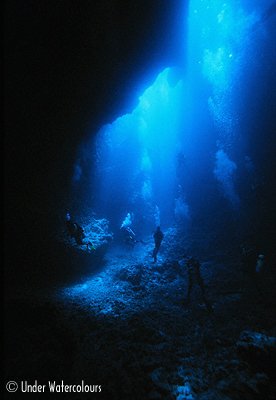
Some time on the boat to let residual nitrogen dissipate, some ice tea and a power bar later, we were ready for Blue Hole. Despite being Palau's signature dive location, I'll admit I didn't know much about it. Turns out there are four adjacent blue holes, very close together. These are literally "fence post holes" in the surrounding coral and limestone with a top entrance of maybe 10 yards across. They're vertical, and you don't swim down so much as fall down them. They're naturally formed, covered in life and eerie. After popping straight down to 90 feet, looking up at this cathedral of life with the sun beaming in through the top is breathtaking. Shaped like an upside down wine glass, the bottom is much larger than the top, but shaded and dark. There are windows or escape holes - some small, and some able to accommodate 4-6 divers at once. Despite all the movement over walls this week, and the various deeper descents and tunnels, this was flying.
I floated up at will to the arches to see the life exploding in this sistine chapel of the sea, with electric clams and exotic shrimp. There's also a grave marker in there of a Japanese diver that stayed forever in the cavern. The space, the light, the only sound being my own breath - it was humbling.

Reef Shark & Fish - Robin Ridilla
We left through a large window at 60 feet and were immediately surrounded by fish, wall coral, patrolling reef sharks and all of it spectacularly colored - probably due to the darkness of the hole we'd been in. It was stepping from the Vatican into Times Square and overwhelmed. Imperceptibly at first, the current began to pick up with every few moments, until you no longer needed to propel yourself. We drifted slowly at first accelerating more and more through vast schools of bright fish. They didn't move out of the way and would pass inches from your face, and I, theirs. We could see the top of the plateau and fish streaming over, all the while with deep blue on our right, sharks penning us in, lest we escaped in that direction. We crested the reef tableau and as we'd gotten spaced out a bit, our diver master got 2-3 people to hang on to wait here. Flowing fast now, I flew backwards into this group, grabbed and swung violently head into the current and made for a grab. I couldn't keep my place despite swimming as hard as I could, so descended until I was grabbing something that wouldn't cut my fingers open. I looked up to see an 8 foot reef shark in the blue abyss 20 feet off the wall turn back our way. Reminiscent of the wizard of oz, when turned he too was pushed sideways at speed. He may as well have suggested he'd get our little dog too as he was moved out of sight, pushed far behind us by the hand of the sea. We let go and continued our backwards flight over the reef, passing schools of barracuda, knowing our biggest fear was crashing into one another. We surfaced 15 minutes later and a kilometer away. It was a truly remarkable end dive, one for the retelling for years. I was last onto the boat, my Palau diving now bittersweetly over.

This was special and a day I'll always recall. Facing my own fears, witnessing the majesty below, then being propelled by forces greater than myself reminded me how small I am, and how much there is yet to see. Sometimes circumnavigating the globe, connecting worldwide and mastering our own domains we forget we are here by the good graces of nature.

Sunday, May 27, 2012

Travel Blog: Part 7 - Diving, Diving and More

It's been an intensive couple days of what I'm starting to see as a diving lifestyle. (Yes, there's a lifestyle for this, just as there is for go-carts, or golf or gardening). To begin with the activity, I've been doing two days of three dives a day, which doesn't sound like much - six hours give-or-take in the water, but the prep. and associated planning for it adds many more hours.

I spoke a little about Peleliu last time, but it's a once in your life dive site, and there's people here that have been back to Palau multiple times and never had a chance to do it. I was lucky. (understatement, await the irony, ok, moving on.) The key to Palau diving I've discovered are the currents, which direction they run, how strong they are on a given day and so on. The currents drive the wildlife that shows up as fast flowing currents = food sources. So your bigger animals come for the current-provided food, and the divers 'hook-in' and watch the show. Palau is uniquely situated to be the junction point of a number of these pacific currents, and how they break over this little mushroom-shaped archipelago of limestone and volcanic rock delineates the best dives sites. (ok water flow lesson over. For homework, read up on water thermodynamics in Chapter 6, and there will be a test next Tuesday).

White Tip Reef Shark - Robin Ridilla
Peleliu, like Ulong Channel and the two Sias sites I dove yesterday are all strong current areas were oceanic walls have crevices, and the above-mentioned currents flows over the reefs into the deep blue. Think of these as underwater waterfalls, where the big stuff comes to feed on the small stuff and they are there to see what flows from the top. The currents are affected by lots of things and there was a recent big storm close-by, a typhoon that is moving north out of Iowa Jima as we speak and that means the normal currents are disrupted. All this by way of background to highlight the couple different schools of diving. There's your eager newbie that just enjoys the sights and being in an other-worldly situation, and I place myself in that group. There's your big game list types, that come just for the tiger sharks, whale sharks or spotted eagle rays. Then there's the mico-macro school, who place themselves on top of the others (diving = high school..a little) who are here for exotic nudibranches, which isn't what it sounds like, and revel in the exotic ultra-small finds on the walls and in the coral. All are interesting to dive with, and the composition of the personalities on your boat on any given day will drive the focus of the dives a little.

I've dove for the past few days with a group of Americans who formed a Wednesday dive club in Guam where they live, and have all come down for a vacation. It's a very experienced group, and they fall into the macro-micro school, though it's fascinating to talk to them, as they also can highlight extremely rare fish we see, which I would otherwise not recognise as being extraordinary. It's all incredible for me. But now I can say that I'm looking for centimetre sized mollusks on the walls too, and appreciating the galaxies of life I'm seeing the size of a fruit basket that seem to exist down deep every few feet. Of course as you fly past a wall, I'll admit to keeping en eye out to the deep blue as well to catch a 6-8 foot reef shark materialise from the gloom. Even these other experienced divers still marvel when the sharks come in close at your height for curiosity and you can reach out and touch them (not advisable by the way). There's literally huge wow factor going off everywhere you look. I find myself saying it aloud into my regulator, which makes me smile and let's water in. Anyway..

For myself, my favourite dive yesterday yesterday was the one that began with a fast descent to 100 feet (broke my own newly established record, and got to 114 feet down yesterday). This is Sias Tunnel, a 250 foot long tunnel under the sea wall. Quite dark, and it's akin to swimming in a cave. The depth makes it intimidating as I can't spend more than 5 minutes in that depth situation without getting bent (more on that later) but very adrenaline producing. We came up the wall after that, with groups of sharks flying formations around us, incredible corals I might only compare to 20 foot cauliflowers flowering before harvest, and trillions of fish. From fingernail size to 100 pounds, in schools and on their own. We saw circling balls of hundreds of fish being hunted, groupers chasing smaller prey, in turn being pursued by sharks, and we topped out on the coral garden amidst a fast drift, did our safety stop and then explored the reef top in 20 feet of water. I found a little moray eel protecting it's cave, and more turtles. It was mind-blowing.

Today's plan (I say plan as you can never be too sure until at the dive site), is to do my last two dives and Palau's signature sites, Blue Corner and Blue Hole. I'm told visits to these sites are never alike on any given days but I do know that regardless of the dive, it'll be sad to get out of the water this afternoon, recognizing its my last time as a privileged observer in this blue paradise.

Saturday, May 26, 2012

Travel Blog: Part 6 - Diving

Ok - one word here captures it: WOW

Magnificent Aquarium - Robin Ridilla

I've just completed dive 5 of 10 that I scheduled and I'm blown away by the diving here. Yesterday was good, equal to anywhere else I've been, not superlative but I literally did jump into the water on top of a sea turtle and reef shark at the same time. Visibility was ok, but a typhoon has just passed through the area, the sea was rough and we were rained on. (oh no, i'm getting wet while I dive!). We were back relatively early though - left at 9, back by 3pm, and I learned afterwards that day one usually happens in this 'safe' place. They're assessing us as we spend time.

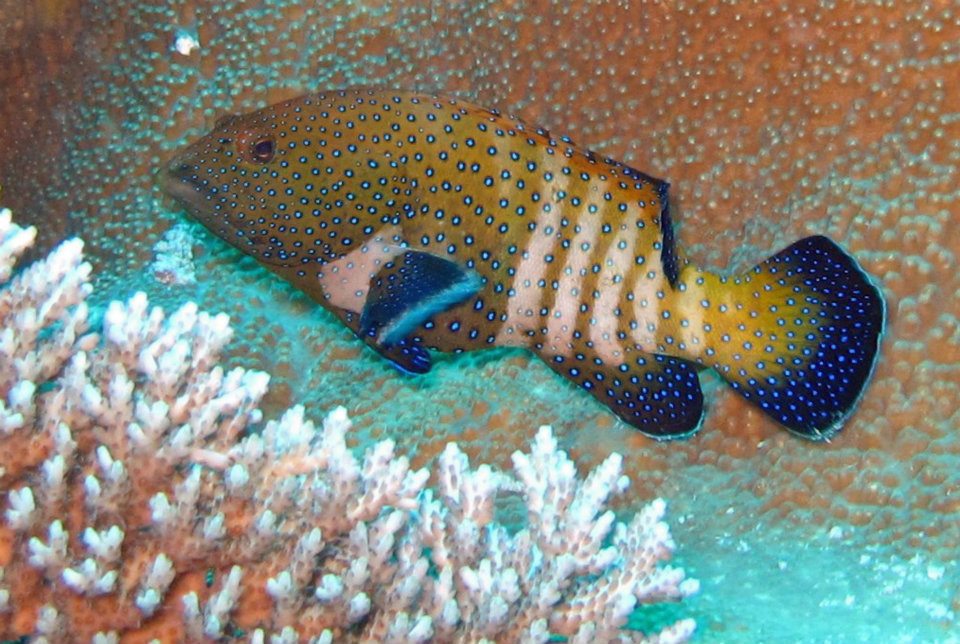
Spotted Grouper - Robin Ridilla
I guess I passed muster, so I signed up for one of the epic spots for today - three dives (instead of two normally) at the south end of Peleliu, including the famed Peleliu Express where people get washed out to sea. I set a few new down time and depth records for myself (went more than 100 feet down), and was able to stay with the group for almost 70 minutes. I also tried nitrox today. Before you go and phone my mother that Steve's doing funny island drugs, it's actually a nitrogen/air mixture you breath and gives you super powers. It does require a special certification, but I had dive master guidance, so what happens on the boat...

Blue TriggerFish - Robin Ridilla
The dives were wonderlands of walls, coral gardens, magificent currents, and the sea life was stunning. I'm not exagerating when I say there were millions of fish. Bright corals, some as big as cars. Schools that took minutes to pass, 4&5 bigger sharks at a time, and one almost always in view, and on the last dive, at least 10-12 sea turtles. We saw rare stuff like large spotted eagle rays glide by, and 50lb bubble headed parrot fish bullying their way around the reef. If you looked close, there were clown fish in anemonies (probably spelled that wrong)and giant clams the size of small horses. The area around Peleliu is remarkable as it's a wall dropping to wherever the bottom is, and so it's where the deep blue sea meets the island coral gardens. It's an intersection of the pacific and truly remarkable. I've found this on youtube (click the word) and have only seen the first 1 minute due to great bandwidth here but even as this glimpse offers, it really is breathtaking.

If I was never able to dive again, I'd be heart-broken, but at the same time I recognize what I participated in today was absolutely phenomenal.

Friday, May 25, 2012

Travel Blog: Part 5 - Palau First Impressions

I had an idea what to expect, and I was wrong. I imagined a somewhat run-down version of a Hawaiian town, lush sure, but quiet and a little sad. If it was a person, it'd be someone who had spent too many days in the bar, and needed a good bath.

I thought it would be something nicer than the Philippines (the closest neighbouring country by the way) but not by much, after all it's too far out of the way, and would have an economy that was heavily dependant on imports for everything except sunburn and saltwater.

But as I said, I was wrong.

When I arrived in Palau last night, I'll admit a sense of fatigue and joy colored my observations. I was biased - pleased to have my outward journey over, and hopeful as what I'd find. I felt Palau was a country-village, and by that I don't mean a village in the country, rather it had the feel of a village who happens to have it's own flag, territory and international recognition. I'm lucky enough to have travelled a little and I saw reminders of numerous places I'd been, Cebu in the Philippines; Peru's jungle frontier, and the island towns of Hong Kong. The landscape also impressed me as I'd expected flat and it's nearly all vertical and heavily forested.

Dawn though brought light and a sense of expectation - not simply about my activities but also about Palau. With some sleep, I felt there should be more to it. After all, this country gained it's independence from the US in 1994, and that's not that long ago. It has a fascinating history, starting life as one of the Carolines Islands, a name like Transylvania in that we have probably all heard of it, but can not locate it on a map. The Germans were 'sold' Palau in 1899 - and the kept it until the end of WWI, when it was stripped from them and given to the Japanese. The era under Japanese management which ended with the closing days of WWII saw the modernification of Palau. Property ownership shifted to individuals from clans and it became a market economy with infrastructure. The Americans ran Palau post the war until 1994, and there are still many obvious ties. All this to say that Palau isn't some little atoll with 1 luxury hotel and a gravel airstrip.

After I dove today, I walked into town (it's about 3kms each way), and while warm, its cloudy and rainy, so not intolerable outside. The walk featured the gamut of human civilization, run down housing, abandoned cars, a general sense of disrepair and decay, stray dogs and chickens pecking the ground near the thing passing for a sidewalk. Superimposed on this were joggers from the national school, juiced up Honda Civic's with too loud mufflers and rap music, neatly trimmed verges and bougainvillea flowering everywhere. The air was thick with the humidity tropical life offers, silky smooth. That same air is acidic on any infrastructure, and even the newest looking buildings showed the mold and stains that are impossible to guard against.

So Palau is building up in a difficult environment. That's the spirit I saw in the people too, friendly and yet astute, genuine and ready to smile easily. This place isn't the night after one-too-many, it's working hard to work.

Thursday, May 24, 2012

TravelBlog: Part 4 - So was 36+ hours flying really worth it ?

I'll admit, I was a tad bored at times.

And I'm quite tired of sitting down. (I asked and they wouldn't let me pedal)

But, as trips go it was survivable, though if planned again with the benefit of hindsight, I'd have elected to go the faster route as while it represented more breaks, this was a long couple days. I say that as someone that used to say a trans-pacific trip was more desireable than the short 6 hour red-eye Atlantic hops as you could eat, work, watch a movie and still get 6 hours sleep. Very civilized vs arriving bleary eye'd at dawn. Emphasis on "used to".

Even with the previous post in mind (the joys of the big airbus)I would still have gone 'faster'. The A380 by the way was unearthly large, and quiet. I walked it and there was just cabin after cabin after cabin. I even lucked out with an empty seat beside me, and so had the empty neighbour's tail camera on their personal video screen for the whole flight. Mounted high in the tail, it offers a plane-in-front forward view. That was a great perspective.

Still, the hard parts weren't the flights so much as the connecting times. 5 hours in Frankfurt, 3.5 hours in Tokyo and 3 hours in Guam. Fighting a 13 hour time difference, and knowing I wanted to sleep in a real bed tonight, I struggled to stay awake. It was one of those trips where a delay might have been welcome, but everything worked. The irony is rich.

The lesson here for us all ? Live and learn. Approaching my destination finally..can't wait.