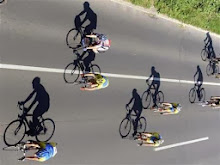
Ok, call me names here, but I think that the pursuit of Lance Armstrong with performance enhancing drugs (PED's) allegations is a misguided, mean spirited and frankly a stupid vendetta.
Here's my rationale - and it actually has little to do with whether Lance used PED's or not. (I would be remiss if I also note that there has not been any hard evidence made public, and there is evidence in the form of the hundreds of test we had to do over the years that he was not found guilty, at the time).
The first part of this defence of Lance is that he's being singled out because he won. Sure other riders have been found guilty, but that's because they tested positive at some point - Lance didn't get caught if I look at this in the worst possible light, and so he's been pursued and that equates to "presumed guilty". Where I live, that's not how justice works. We aren't going after the 2nd, 3rd, 9th place finishers as no one cares about how they achieved their results, provided they passed the tests at the time as Lance did.
The second aspect of the defense is the reality of professional competition, whether in the Tour de France, the Olympics or various World Championship forums. The desire in all these situations is to win, and that carries incredible amounts of financial, patriotic and personal pressure. Do we really think that the one person that wins is the only one using any kind of performance improvement ? Are we really that naive ? Every rider does something, every sprinter pushes the limits into the grey zone, and every weightlifter uses whatever it takes to win. The key -like professional burglary- is to avoid getting caught. To not 'use', and suffer the performance penalty has to be a worse option that winning and possibly getting caught. Look at professional baseball losing two star players just this week to this 'scandal'. Why do it ? Well in the latter case I imagine it's to land greatly rewarding contracts. For the athlete it's got to be easy to rationalise as doing what it takes to stay even. If everyone does it, then are we still looking at the best athletic performance to win..yes. If we test for the substances and practices, and don't find them, don't we have to assume that the race/competition was done on even grounds (as in with or without PED's) and the winner is actually the winner. I think so.
The last aspect of my defense here is the timing. Lance isn't competing any longer. He's hung up his racing shoes. So, the question begs why now ? (Or even - why not pursue Mohammed Ali, Carl Lewis, George Best or Eric Heiden) What is it about Lance Armstrong that drives these sporting authorities to chase him ? Is it his closely held political views or his potential to be a troublesome candidate from Texas. Perhaps. These days we may still be naive about sport, but we aren't about politics, and this coordinated movement (now) against Lance smells like politics. After all, the guy survived cancer, founded a very successful non-profit, dabbles in celebrity and seems squeaky clean - on top of being an American athletic legend. He's a heck of a potential candidate for anyone, and without declaring red or blue...all need to fear him, and neutralise him.
I'd suggest that the man's accomplishment's are celebrated, because in the playing field at the time, he won, then he won again and again and again and again and again and again. That spells extraordinary achievement any way that you cook it.
Friday, August 24, 2012

Thursday, August 23, 2012
Tripping
The value is in the journey, not the destination.
 That's our mantra when we go into the woods, though it's probably worth remembering when embarking on other things as well. When we do go into the woods, we prepare like crazy, and try to think through all the variations that could happen - planning wins the day, and all of what we bring has to be woods-tested and very light as after-all we have what we carry on our backs and no more. I say "backs" but I mean our canoe in this case. For anyone unfamiliar with the word "portage" it means you carry all that's in your boat, and your boat (on your head), so that makes weight a concern.
 Our tripping took us to a park that we hadn't visited before - on the water. Killarney in Ontario where the typical outdoors experience is complemented by quartzite mountains. This adds to the scenery certainly, and makes the trip worth the views alone. It also means you are moving from lake to river to lake across mountains at times, and funny thing about mountains - they're uphill. (hence the weight concern)
The park is remote, but legendary enough that it draws people far and wide, so we did see plenty of others in the wilderness. You'll have to understand my perspective on this when I say plenty - as we have been in the woods for a few days and never seen a soul. Plenty means perhaps 4-5 other parties a day, and often on portages and campsites we pass by. It's not Christmas in the mall.
 The tripping went well - we accomplished our pre-designated routing and saw what we wanted to see, but we planned poorly in one sense. You see we didn't build in 'down-time' activities, as the last few trips we'd done were about the 'movement'. Our schedule normally has worked like this: you break camp by 08:30 or so, having had breakfast, packed up, and cleaned the site so it's spotless for the next adventurers. Then you go about your route for the day, stopping as you need a break, and for lunch, and often at the end of particularly arduous portages. (A few km's with a pack and canoe on your shoulders, up and down steep hills pushes you a little). You arrive at the next night's campsite about 4-5pm and get set up, think about dinner, get a fire going and so on. There's down time certainly, but we don't build in relaxing time as such. We don't bring chairs, or books, or fishing gear - these just aren't those kinds of adventures for us. Killarney as beautiful as it is is smaller than we were used to, and so we were completing our day's trip by lunch time. While that certainly isn't bad, the truth is we hadn't planed for a set of half-days, and hence it wasn't attractive to us as an experience.
The first afternoon we ended up storing our boat in the woods on the lake we would sleep on, and packed up our load to the highest local mountains just after lunch. We aimed to do a 10km or so trail and got lost, so still probably covered some distance, but found our way back to the boat a little tired, chagrinned and more than aware that Teva's are great water sandals, and not so good for mountaineering. Still we were at camp by 4pm. The next day, we were on our camping lake by 11am. So we pushed out of the park a day early.
In hindsight, we did what we aimed to do, though if I was going to do it again tomorrow, I'd pack differently, with more campsite (luxuries) that we could pass the time with. I like relaxing as much as the next person. I don't feel that we 'failed' in any way either, just that we'd planned poorly. That meant we couldn't enjoy the full potential of the journey we undertook.
 That's our mantra when we go into the woods, though it's probably worth remembering when embarking on other things as well. When we do go into the woods, we prepare like crazy, and try to think through all the variations that could happen - planning wins the day, and all of what we bring has to be woods-tested and very light as after-all we have what we carry on our backs and no more. I say "backs" but I mean our canoe in this case. For anyone unfamiliar with the word "portage" it means you carry all that's in your boat, and your boat (on your head), so that makes weight a concern.
 Our tripping took us to a park that we hadn't visited before - on the water. Killarney in Ontario where the typical outdoors experience is complemented by quartzite mountains. This adds to the scenery certainly, and makes the trip worth the views alone. It also means you are moving from lake to river to lake across mountains at times, and funny thing about mountains - they're uphill. (hence the weight concern)
The park is remote, but legendary enough that it draws people far and wide, so we did see plenty of others in the wilderness. You'll have to understand my perspective on this when I say plenty - as we have been in the woods for a few days and never seen a soul. Plenty means perhaps 4-5 other parties a day, and often on portages and campsites we pass by. It's not Christmas in the mall.

The first afternoon we ended up storing our boat in the woods on the lake we would sleep on, and packed up our load to the highest local mountains just after lunch. We aimed to do a 10km or so trail and got lost, so still probably covered some distance, but found our way back to the boat a little tired, chagrinned and more than aware that Teva's are great water sandals, and not so good for mountaineering. Still we were at camp by 4pm. The next day, we were on our camping lake by 11am. So we pushed out of the park a day early.
In hindsight, we did what we aimed to do, though if I was going to do it again tomorrow, I'd pack differently, with more campsite (luxuries) that we could pass the time with. I like relaxing as much as the next person. I don't feel that we 'failed' in any way either, just that we'd planned poorly. That meant we couldn't enjoy the full potential of the journey we undertook.
Tuesday, August 7, 2012
I Got Fired Today
Not a great day, as days go.
Sometimes, despite our best efforts, we don't do well enough against the established standard, and that's what happened I think. I regret it happening as it doesn't feel good, but intellectually I understand the decision and I know it didn't happen because I slacked off, or didn't put enough effort into it.
Specifically, I was fired from an associated commitment I had - teaching a segment on sales system automation at a locally respected business school (university). This is something I did that was above and beyond my normal work-life. I enjoyed it, and tried to pass along the benefit of my experience. I think I was successful in doing that, but by an objective measure, that's also not what I was there to do - I was asked to address an area of business life that is painful and problematic for almost everyone, and to do so within a mixed group of 20 or so people from different companies, in three hours time. My remit sat amidst other learning these same people had taken on - ranging from conceptual and theoretical ideas about how sales and marketing work together to presentation skills.
The disconnect happened in expectations I think. You see my area was almost the only one where the audience had some previous experience, and came into the time we had together with genuine pains. I differentiate this from a more generic desire to know more, or work smarter in general. In many ways, I was asked to try to do the impossible, and I saw that and discussed it with those that had assembled the couse materials. But at the end of the day, participants rate these courses, and we live or die by these ratings. I've no issues with that - just that my judges addressed my work as to whether it was applicable to, and/or solved their issues vs the other presenters who would have been judged on whether the ideas were good, or potentially offered an implementation pathway towards working better. I'd offer a medical analogy of a class wanting to know about practicing medicine in general, who arrive in this session with a stomach ache. My task was to educate them, and cure the stomach ache - everyone else just had to educate them.
So, in taking on the impossible, did I see this as a potential outcome ? Yes, but I didn't acknowledge it as a realistic outcome - again with mismatched expectations.
One of the little sayings I like is that if you don't fail 20% of the time, you're probably not trying hard enough. I'm going to chalk up this experience to that I think - I tried to do the impossible and failed. I'm glad I tried though.
Sometimes, despite our best efforts, we don't do well enough against the established standard, and that's what happened I think. I regret it happening as it doesn't feel good, but intellectually I understand the decision and I know it didn't happen because I slacked off, or didn't put enough effort into it.
Specifically, I was fired from an associated commitment I had - teaching a segment on sales system automation at a locally respected business school (university). This is something I did that was above and beyond my normal work-life. I enjoyed it, and tried to pass along the benefit of my experience. I think I was successful in doing that, but by an objective measure, that's also not what I was there to do - I was asked to address an area of business life that is painful and problematic for almost everyone, and to do so within a mixed group of 20 or so people from different companies, in three hours time. My remit sat amidst other learning these same people had taken on - ranging from conceptual and theoretical ideas about how sales and marketing work together to presentation skills.
The disconnect happened in expectations I think. You see my area was almost the only one where the audience had some previous experience, and came into the time we had together with genuine pains. I differentiate this from a more generic desire to know more, or work smarter in general. In many ways, I was asked to try to do the impossible, and I saw that and discussed it with those that had assembled the couse materials. But at the end of the day, participants rate these courses, and we live or die by these ratings. I've no issues with that - just that my judges addressed my work as to whether it was applicable to, and/or solved their issues vs the other presenters who would have been judged on whether the ideas were good, or potentially offered an implementation pathway towards working better. I'd offer a medical analogy of a class wanting to know about practicing medicine in general, who arrive in this session with a stomach ache. My task was to educate them, and cure the stomach ache - everyone else just had to educate them.
So, in taking on the impossible, did I see this as a potential outcome ? Yes, but I didn't acknowledge it as a realistic outcome - again with mismatched expectations.
One of the little sayings I like is that if you don't fail 20% of the time, you're probably not trying hard enough. I'm going to chalk up this experience to that I think - I tried to do the impossible and failed. I'm glad I tried though.
Friday, August 3, 2012
Shanghai
Work took me to China this week – a long haul for 3 days to
be sure, but interesting and instructional all the same. Few places in the world look like China
– the ultra modern (bordering on garish) architecture emphasized with neon
light shows. There’s a correlation
here usually – the uglier the building, the more dramatic the multi-colored
lighting effect. The city hums
which in 35-43 degree heat (that’s ‘really hot’ to you Fahrenheit types) is all
the more amazing as the latin siesta approach has never taken root here.
Shanghai is special amongst Chinese cities, with its
historic Bund district of western decadence and seemingly more commercial focus
too – Beijing can have the ‘State’ power
structures, we just want to have fun and make a few yuan seems the city’s
beck and call. Like New York and
Hong Kong, it burps and throbs in barely concealed energy. It’s exorbitantly pricey and dirt cheap
at the same time. It’s also a real
tourist mecca for the Chinese themselves, with the waterfront boardwalk heaving
with picture takers from all over this big country.
 Shanghai has some tremendous infrastructure, the magnetic
levitation train for example that runs from the airport to the city (sort of)
capable to speeds up to 400 km/h.
But it arrives at an odd, non-central location. Subway’s criss-cross the city, but
where they connect, you actually come up to ground level, and go back
down. It’s a city of
visionaries, where the wow-effect is much more important than usability.
Shanghai has some tremendous infrastructure, the magnetic
levitation train for example that runs from the airport to the city (sort of)
capable to speeds up to 400 km/h.
But it arrives at an odd, non-central location. Subway’s criss-cross the city, but
where they connect, you actually come up to ground level, and go back
down. It’s a city of
visionaries, where the wow-effect is much more important than usability.
English capabilities and sign-age is smattered across the
landscape – billboards and international brands deceptively suggest
multilingualism where very little exists.
Don’t get into a taxi unless you have your address written in Putongua –
and even then you’ll argue with the driver who doesn’t feel like going in that
direction. (Did I mention it feels
like 45 degrees out there on the street ?)
China remains a study in complimentary contrasts and
Shanghai is its’ darling.
Friday, July 27, 2012
Health - The Verdict
I promised an update and I keep my promises.
The last six week of eating healthy had their share of advantages and disadvantages. I was at home for much of the time, but also travelled for business in the period which was bound to make things more complicated. I cheated a couple times - this was a voluntary thing after-all - though the extent of the cheats was small and not material.
Overall ? I feel better. Hard to characterize it beyond that, but I'll attempt to nonetheless.
You know that stressed, tired feeling you have in your brain/mind/soul when you're just about to go on a needed vacation ? And the result of the vacation - where you are not stressed, regain the bounce in your step, and feel mentally refreshed ? Well, that's the closest thing I can compare how it physically feels. I'm fractionally lighter, tighter, and I do feel better.
Was it worth it ? Absolutely.
Will I do it again ? Yes, in fact I plan to go back to this style of eating as soon as I'm back from my current business trip.
Which brings me to the downsides - there isn't great choice, and some of the choices, inventive as they are, just don't taste very good. Bread products without that gluten aren't that nice - or at least I've not found any that I'd buy again, or want to consume again. I'm probably lucky that that hasn't been a big downside for me. I can take it or leave it as far as bread goes. Convenience (and bacon) is what I missed the most. The ability to make simple choices was gone. I had to really concentrate on what was on each food I ate, much like a real sufferer of Celiac disease. That frankly was a pain for a person like me whose big decisions in the past was which fast-food place to stop it (not if I could).
I managed to survive a business trip and stick to the plan while in San Francisco, but as I'm off to Asia at the moment, I think that's going to be impossible.
What did I end up eating ? Lots of fruit and veggies, some fish, and I even found gluten free chips (Boulder - yum!), and ice cream - (Breyers..who knew?). Hey this was an experiment, not a monastery commitment.
Should we all do this ? Well, those who've read more than one of these posts understands that I try to never tell people what they should do, but rather I encourage you to understand your own decisions and make peace with them, or change them. In this case - I'd suggest you also tried this. You might also like it. If you don't, the downside is that you might get temporarily healthier. Not much of a price to have to pay, now is it ?
Overall ? I feel better. Hard to characterize it beyond that, but I'll attempt to nonetheless.
You know that stressed, tired feeling you have in your brain/mind/soul when you're just about to go on a needed vacation ? And the result of the vacation - where you are not stressed, regain the bounce in your step, and feel mentally refreshed ? Well, that's the closest thing I can compare how it physically feels. I'm fractionally lighter, tighter, and I do feel better.
Was it worth it ? Absolutely.
Will I do it again ? Yes, in fact I plan to go back to this style of eating as soon as I'm back from my current business trip.
Which brings me to the downsides - there isn't great choice, and some of the choices, inventive as they are, just don't taste very good. Bread products without that gluten aren't that nice - or at least I've not found any that I'd buy again, or want to consume again. I'm probably lucky that that hasn't been a big downside for me. I can take it or leave it as far as bread goes. Convenience (and bacon) is what I missed the most. The ability to make simple choices was gone. I had to really concentrate on what was on each food I ate, much like a real sufferer of Celiac disease. That frankly was a pain for a person like me whose big decisions in the past was which fast-food place to stop it (not if I could).
I managed to survive a business trip and stick to the plan while in San Francisco, but as I'm off to Asia at the moment, I think that's going to be impossible.
What did I end up eating ? Lots of fruit and veggies, some fish, and I even found gluten free chips (Boulder - yum!), and ice cream - (Breyers..who knew?). Hey this was an experiment, not a monastery commitment.
Should we all do this ? Well, those who've read more than one of these posts understands that I try to never tell people what they should do, but rather I encourage you to understand your own decisions and make peace with them, or change them. In this case - I'd suggest you also tried this. You might also like it. If you don't, the downside is that you might get temporarily healthier. Not much of a price to have to pay, now is it ?
Wednesday, July 25, 2012
Looking forward, looking back
Much like New Year's, a birthday seems like the right time to both reminisce about the times that were, and cast your eyes forward to what's ahead. Tomorrow is my birthday, so indulge me while I wander the synapses of recollection of my early life and recall some key moments. These will clearly mean more to me than you, but like anything else, a glimpse into how another looks at things, is often instructional for each of us as we consider how we approach the same thing.
My earliest memories are in a row-boat. I think my mother and father are there too. As I recall it now, it looks like New York's Central Park, which is of course not possible as I wasn't ever there until years later. That's what the movies will do to you.
When I was older, but still young, we lived on a lake. We moved up there and I was united with my new family. I recall visiting before the move, and huddling in the corner, trying to be invisible to all the noise and activity of four other kids around me. Memories in that house weren't all frightening though - I also recall my mother ironing in our living room as we were watching the moon landings on our b&w TV. It was a renovated cottage - a summer home, and had lots of great places to hide, including the TV ariel that would have been 100feet high. I could climb it and go up onto the roof - our dog never found me there. I also recall jumping on my Dad - Kato-style from the Pink Panther movies. I'm sure that exactly what he was hoping for after a long day of work, and a big commute. (does yur dog bite?)
In spring and autumn before the lake was frozen solid - in those freezing/thawing times of the year, I'd go out alone in our little un-sinkable aluminium canoe and play 'ice-breaker'. I had to wander far-out and now I look back and wonder how I didn't flip it and drown. I had a sense of confidence in that little boat as it was rimmed in styrofoam, not quite understanding how the frigid water wouldn't have been so kind to my little body. I wasn't quite as unsinkable of course.
Many childhood memoires involved our dog - and long stretches playing by ourselves. To my mind, I'd go out in the morning, and show up again at dinner time. Of course, my ability to playback episodes of Gilligan's Island and Hogan's Heroes means I also spent some time on the couch.
If I relate this to my own kids, I can't say I let them be as wild as I sensed I was. Granted it was different times, but that's as much to do with the speed of information sharing these days as anything else. I enjoyed being a kid and hope my own children did too. I was free then and while I did find my fair share of mischief, I could express myself in making a fort in the woods, or building an army base through the garden (sorry Mom), or trying to see how I could get the lake to catch fire. (Don't ask)
Getting older probably places a rose-coloured lens on earlier days, but that's not a bad way to consider your own life. Looking back, I wouldn't have wanted it any other way.
My earliest memories are in a row-boat. I think my mother and father are there too. As I recall it now, it looks like New York's Central Park, which is of course not possible as I wasn't ever there until years later. That's what the movies will do to you.
When I was older, but still young, we lived on a lake. We moved up there and I was united with my new family. I recall visiting before the move, and huddling in the corner, trying to be invisible to all the noise and activity of four other kids around me. Memories in that house weren't all frightening though - I also recall my mother ironing in our living room as we were watching the moon landings on our b&w TV. It was a renovated cottage - a summer home, and had lots of great places to hide, including the TV ariel that would have been 100feet high. I could climb it and go up onto the roof - our dog never found me there. I also recall jumping on my Dad - Kato-style from the Pink Panther movies. I'm sure that exactly what he was hoping for after a long day of work, and a big commute. (does yur dog bite?)
In spring and autumn before the lake was frozen solid - in those freezing/thawing times of the year, I'd go out alone in our little un-sinkable aluminium canoe and play 'ice-breaker'. I had to wander far-out and now I look back and wonder how I didn't flip it and drown. I had a sense of confidence in that little boat as it was rimmed in styrofoam, not quite understanding how the frigid water wouldn't have been so kind to my little body. I wasn't quite as unsinkable of course.
Many childhood memoires involved our dog - and long stretches playing by ourselves. To my mind, I'd go out in the morning, and show up again at dinner time. Of course, my ability to playback episodes of Gilligan's Island and Hogan's Heroes means I also spent some time on the couch.
If I relate this to my own kids, I can't say I let them be as wild as I sensed I was. Granted it was different times, but that's as much to do with the speed of information sharing these days as anything else. I enjoyed being a kid and hope my own children did too. I was free then and while I did find my fair share of mischief, I could express myself in making a fort in the woods, or building an army base through the garden (sorry Mom), or trying to see how I could get the lake to catch fire. (Don't ask)
Getting older probably places a rose-coloured lens on earlier days, but that's not a bad way to consider your own life. Looking back, I wouldn't have wanted it any other way.
Tuesday, July 17, 2012
Hippo's, ABC's and Intution
There is a fascinating shift going on beneath our noses, and you may not even be aware of it. Much of it revolves around the ideas of what intuition offers us, and how we have historically and perhaps mistakenly trusted it. I grew up believing intuition as a positive thing - it was borne of experience and reflected sound judgment, and was what you fell back to when the path forward wasn't clear. Like many things in modern life though, the role of intuition seems to have been blurred with opinion and the sound-ness of it isn't always what we thought it was.
Here's an example question that I'll admit having some fun with recently. I read it in Daniel Kahneman's recent book Thinking Fast & Slow (A great read). The idea is to instinctively react to it, and at the same time, listen to your own brain in the process. It goes like this:
A ball and bat together cost $1.10
The ball costs $1.00 more than the bat
How much does the ball cost ?
Easy yes ? Well, not for everyone. Our intuitive brain is wired to do the fastest and simplest of maths here, and arrive at the answer that the ball is $0.10. That's the wrong answer of course. (This is where you go back, re-read it and think about the answer.) That process of thinking illustrates to you that the ball actually costs $0.05. You see, you were deceived by two factors here - the deceptive phrasing tricked your intuitive processes, and your brain lazily allowed intuition to carry the answer, without stopping to think if it was actually the correct answer. According to Mr. Kahneman, we do this frequently and automatically, and he offers many great examples where extensive testing has been done to prove this out. You see thinking slowly and deliberately uses lots of energy, and our bodies are hard-wired to avoid high energy usage brain activities unless we have to - some switch inside each of us controls this. I won't go into more details, if this is interesting to you, read the book.
What does this have to do with Hippo's and ABC's ? I'm glad you asked that.
There are related ideas in something else I came across, about A&B testing and how decisions are made. It correlates to the inconsistency or at least pollution of the purity of intuition as well. A&B testing is happening all around you. For all I know, you're experiencing it as you read this page. It's the subtle ongoing testing of varying page layouts in our online world, and reflects very small changes to increase levels of engagement. Perhaps you've had a "Matrix-moment" where things seems a little different to you ? You aren't crazy, you are seeing different things. It seems popular sites - the Google's, Yahoo's and others don't amend their look and feel all at once, they evolutionize them though A&B testing. A subtle small change is designed and floated out in live time to perhaps 10% of the user population. The engagement level (against the baseline of existing page users) is measured and the more successful page becomes the new standard, until it's evolved. Clever..yes. If the goal is to get us to click-through more ads which it often is, then it works. But - what's this got to do with intuition ?
The other way to make changes is to do it based on what people think. That's the historic model that delivered to us the iPod design, sleek sports cars and the Guggenheim museum. When I say people, I mean select people, or even more precisely in an organization, the highly paid people who should know about these things using their .... wait for it .... intuition. The problem with this approach, is that we don't all have the gifts in design that Steve Jobs or Frank Gehry have. Instead we have business leaders that have opinions, and bias's and their authority can carry the day under the guise of intuitive design. They are the Hippo's - highest paid person's opinion... and they are often as not wrong. The purpose of the A&B testing is to rely on the data of engagement levels to determine if change should occur - they are the business world analytics version of thinking slow.
So the upshot of all this ? I wish you all the energy and time to make thoughtful decisions. Our world doesn't suffer time spent thinking slowly positively, but it's clearly worthwhile.
Here's an example question that I'll admit having some fun with recently. I read it in Daniel Kahneman's recent book Thinking Fast & Slow (A great read). The idea is to instinctively react to it, and at the same time, listen to your own brain in the process. It goes like this:
A ball and bat together cost $1.10
The ball costs $1.00 more than the bat
How much does the ball cost ?
Easy yes ? Well, not for everyone. Our intuitive brain is wired to do the fastest and simplest of maths here, and arrive at the answer that the ball is $0.10. That's the wrong answer of course. (This is where you go back, re-read it and think about the answer.) That process of thinking illustrates to you that the ball actually costs $0.05. You see, you were deceived by two factors here - the deceptive phrasing tricked your intuitive processes, and your brain lazily allowed intuition to carry the answer, without stopping to think if it was actually the correct answer. According to Mr. Kahneman, we do this frequently and automatically, and he offers many great examples where extensive testing has been done to prove this out. You see thinking slowly and deliberately uses lots of energy, and our bodies are hard-wired to avoid high energy usage brain activities unless we have to - some switch inside each of us controls this. I won't go into more details, if this is interesting to you, read the book.
What does this have to do with Hippo's and ABC's ? I'm glad you asked that.
There are related ideas in something else I came across, about A&B testing and how decisions are made. It correlates to the inconsistency or at least pollution of the purity of intuition as well. A&B testing is happening all around you. For all I know, you're experiencing it as you read this page. It's the subtle ongoing testing of varying page layouts in our online world, and reflects very small changes to increase levels of engagement. Perhaps you've had a "Matrix-moment" where things seems a little different to you ? You aren't crazy, you are seeing different things. It seems popular sites - the Google's, Yahoo's and others don't amend their look and feel all at once, they evolutionize them though A&B testing. A subtle small change is designed and floated out in live time to perhaps 10% of the user population. The engagement level (against the baseline of existing page users) is measured and the more successful page becomes the new standard, until it's evolved. Clever..yes. If the goal is to get us to click-through more ads which it often is, then it works. But - what's this got to do with intuition ?
The other way to make changes is to do it based on what people think. That's the historic model that delivered to us the iPod design, sleek sports cars and the Guggenheim museum. When I say people, I mean select people, or even more precisely in an organization, the highly paid people who should know about these things using their .... wait for it .... intuition. The problem with this approach, is that we don't all have the gifts in design that Steve Jobs or Frank Gehry have. Instead we have business leaders that have opinions, and bias's and their authority can carry the day under the guise of intuitive design. They are the Hippo's - highest paid person's opinion... and they are often as not wrong. The purpose of the A&B testing is to rely on the data of engagement levels to determine if change should occur - they are the business world analytics version of thinking slow.
So the upshot of all this ? I wish you all the energy and time to make thoughtful decisions. Our world doesn't suffer time spent thinking slowly positively, but it's clearly worthwhile.
Subscribe to:
Posts (Atom)