Wednesday, August 21, 2013

The Horizon Line

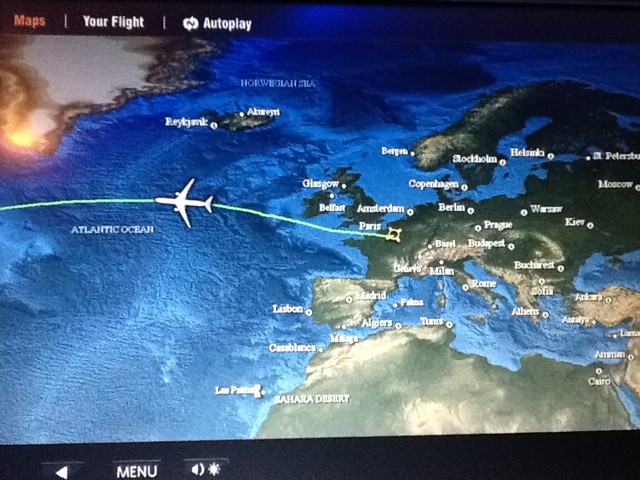
I went around the world this week.  Modern travel makes this far more feasible than that sounds. It's not extraordinary, it simply requires lots of sitting.  Its is special if you've not travelled too much, or perhaps if you envy long periods of sitting. I don't know anyone in the latter situation, but in that sense - it is a big world, so who knows.

I travel for business very frequently, and one of the side benefits of that is the ability to travel for pleasure. Loyalty begets loyalty in this sense, though if I had colds and fever sickness frequently, I don't know that I'd like to be rewarded with more of the same.  Perhaps airlines don't grasp some of the "fun" their own consumption experience entails.

I have come away from this week with the renewed understanding that our planet is indeed small. Getting around it all is easy. It might be a real feat to be on a Jupiter size planet and circumnavigate. Then flying at 1000 km/h, like as on a boat here on Earth,  it might take months or years.  But in our part of the solar system, we're talking about 40 hours of sitting. Big deal.  

What it brings into perspective is our fragility, due to our small size. This is relative of course. Sure, I'd hate to have to walk around the world, but think about the snail or worm's progress across the sidewalk. Then think about the Albatross, Arctic tern or Grey whale that regularly span hemispheric oceans every season.  If animals do this, as part of their innate DNA - then why do we think this is special..?

We would all approach the world differently if we were more migratory as people.  Without being 'travellers', our horizon is our whole world and the empowerment that we offer to the horizon line is self defeating I think.  "If I can't see past it, the places beyond must be far away."  Poppycock.  That's some sort of pre-historic, latency issue that was intended to ensure we didn't get lost from the pack of proto-humans we lived with for self-protection.  If I travel the world, the sabre tooth tiger doesn't get me these days, though duty-free stores may.
The other horizon-line fallacy invoked is that we can we can do what we want to the planet, and it is big enough to recover. (Hence my fragility comment) Problems only manifest past the horizon.  Sure that sounds silly, but look at history - when does the US enter WWII ? Post their islands being attacked. When a bus plunges somewhere in the world, it's only news if 3 XXX's were onboard. (At XXX, insert your nationality here). Polar ice-cap melting? Sure seems cold here in winter still. If stuff happens 'over there', past the horizon it doesn't matter to us as much as if it was right in front of us. 

Imagine for a moment that you are driving in a car, over a bridge.  Over water.  Suddenly, the car veers of the bridge, and into the water and sinks towards the bottom.  

Clearly, you're having a bad day in this car. Underwater.

What becomes evident very fast is that you're about to run out of air, and so effort is made to escape the car to avoid drowning.  That all makes sense, we would all react that way.  And I think the allusion is also clear.  You see we're all in the same car, and it is small, though due to the horizon line..we don't quite acknowledge that yet, this fact that we're in deep trouble.  Even though there's significant evidence to support the fact we're in trouble. 

Ignoring the fact doesn't make our "air" last longer to extend the analogy, it just gives us less reaction time.  Do you think more or less reaction time is beneficial if in that unfortunate situation?

I, for one, wish we'd all understand this horizon line bias that colours our perceptions about our world, as I think it would change how we approached just about everything.  


Monday, August 19, 2013

Summit the Mountain in Front of You

You'll find it's easier than trying to climb a far away or future one. 

Wednesday, August 14, 2013

Stretching

Sometimes we relax and enjoy down time. It's deserved, (or not) and we indulge a little.  Other times though we prepare ourselves, take a deep breath and stretch.  We push beyond our comfort zones knowing it is good for us.   This can happen in a workout or other favourite activity when we go harder for a defined short term - the sprint at the end of a run. Or it can happen over the long haul when we make life altering decisions such as moving away from the single life and deciding to have a family.  There's a middle ground though that I think represents the hardest type of stretch.  That extended but not permanent commitment to something that will do us good over the mid-term.  A year long decision to really change a pattern in your life.  There's no shortcut on these. 

Stretching isn't easy. It requires a degree of self motivation and will power. It requires that we put what's good for us ahead of what's comfortable.  And like anything we decide, there's is a need for commitment to stick with it.  With that in mind, when we see others stretch it impresses us - certainly it impresses me.  I think we place ourselves in the others' shoes for a moment and ask if we could do it.  We consider it, and quickly and if only superficially grasp what is needed for that stretch , for that movement outside where we feel safe.  We recognize it.  

I know someone that's stretching now.  I know she's not 100% ok with it. And I'm really blown away by her personal strength to do it.  I hope to be inspired by  her to explore new areas for myself and I'm not so secretly wishing her tremendous good fortune as we don't see this kind of thing everyday.  

Look around and give yourself a pat on the back if you 'stretch' regularly.  You deserve it.   


Monday, July 22, 2013

We are All Compound People

Some of us have numerous online identities, and some don't.  It can get creepy when an individual pretends to be something they aren't - middle aged men assuming the identities of young people in online communities for example - but I'm not talking about the questionable outliers, I'm thinking more mainstream.  I've heard it recommended more than a few times, that we "professionally" ought to maintain numerous profiles, one for our work, and one to make comments about a few beers with friends or your like/dislike for the favourite local team.  I happen to disagree.

I think we are all compound people - we have a multiple aspects or perspectives in our lives depending on whether we're at work, at home as kid/parent/spouse, or at church or the local biking club.  That's not an exception, that's the normal way we do things.  We exhibit it with our dress (business suit / casual wear / community clothes) and our talk.   When we suppress this idea in the online world, and pretend that we're always professional, or always all about this passion or that one, we are attempting to manipulate people's impressions of us.  Especially if under another online identity, we are making those personal comments or sharing instragrams that are 'unprofessional' in nature. (I don't mean questionable here, I mean not work-related) It is not genuine, and hence begs questions around trust in what's being said - because it's not the whole story.

I support the concept of being one person, and have the people that choose to listen to you understand that there are multiple interests and important aspects in your life.  I put forth that the same is true for each member of your audience, and hence legitimacy is granted.  Your listeners, viewers or audience may not like your entire interests - but that's the beauty of choice.  They can elect to un-listen in the various forms that takes.  For those I listen to, I'm not as interested when they post a picture of their dog, as when they talk about the things that I care about - BUT - and here's the important bit, I know that they aren't hiding anything, and are genuine as otherwise they wouldn't have the guts to say it all.  

There's a side-note here worth saying.  You don't have to post it all, and I'm not suggesting that you do share everything in your life.  If you only want to blog about work topics, or only talk to old friends on FB, that's fine.  Each of us adopts the personality for our circumstances as we require.  Just be straight about it, as we're all compound people.    


Tuesday, July 16, 2013

I'm probably wrong

I've been going through an interesting (for me anyway) mental exercise recently.  You see, I disagree with how someone close to me is treating a 3rd person we both know.  I fear this person close to me will get hurt, and let down, and I don't want to see that happen.  I tried to suggest caution and going slow...to no avail.

I'm not particularly hurt my advice (unsolicited) wasn't heeded - that's not my thing.  Rather I was concerned that we both had seen evidence that trust was abused in the past, and I didn't see that this person close to me had 'learned' from it, as I had.

So I've stewed for a few days.  Not fumed, or was angry in any way, just stewed.  You see this person close to me is probably the wisest person I know.  So the question in my head wasn't.."Why don't they see what I see?"...rather it was.. "What do they see that I don't ?"

I still feel the same way about the situation, and left to my own instincts, I probably wouldn't have done anything that took me off-course from acting in a manner that demonstrated that.  But, I'm putting aside what I think, and acting instead on what they think, and what they are doing.  You see I trust this person close to me, and while I can't get my head around their rationale, I know that's ok - one day I may be able to, and in the meantime, it's better to follow the judgement of someone that you know always makes good decisions.

I don't see it yet -  that I'm probably wrong, and they are right- but one day I hope to.

Tuesday, June 25, 2013

Pay It Forward

This was a lovely little movie from the year 2000 with that oh-so-cute little actor (Haley Joel Osment) that undoubtedly grew up and became less cute.  At least that's the reaction I get when people see the bracelet I wear that says "Pay it Forward".

In fact the concept goes back many many years, and is attributed to many practitioners from Benjamin Franklin, to Emerson and the phrase itself is credited to Lily Hardy Hammond in her 1916 book entitled "In the Garden of Delight".

Pop culture means historic and interesting references give way to movies though - and the movie had a core message that was conveyed in the title and the desire was to make the idea into a movement.  I'm happy to say that Charley Johnson has done that - and founded Pay it Forward, from which my little bracelet comes.  It's a wonderful idea, and one I'm happy to support, thanks to a few very smart people in my life that helped make me aware of it.

The concept is brazenly simple and elegant.  Do something nice for someone else.  Then give them the token (the bracelet in my case), and ask that they pay that kindness forward to another.  I wear it as it provides a constant reminder to me that I should be thinking of others more than myself.  That's what I 'get' out if it.  Being able to do something nice for another person - well that's just a bonus.

Interested ?  Get your own bracelet here.

Saturday, June 15, 2013

Childhood's End

I try to be realistic and relative with new ideas I see, hear or read about, and don’t use labels such as “mind-blowing”, “revolutionary” or associate ideas to Toffler’s “Future Shock“ too easily.  But I've come across one of those concepts, and I’m staggered by it.  The implications are life-altering on a species-level for humanity, and I’m stunned by it’s significance.

I recently wrote about the mountain of data we were on the verge of collecting, and ironically, I think I missed a rather key point.  The real-time reality capture we’re on verge of making happen is but one of the mega-data components we’re enabling today.  The other is the object data, connectivity, rules and implicit implications surrounding the internet of things.  For those uninitiated, the internet of things is the connected-ness of inanimate objects and networking them.  At a macro-level, imagine your refrigerator connected to the web and telling you to pick up some eggs on the way home from home via SMS when you’re low on them.  Clever, yes ? At a more detailed level, it’s the labelling of each individual egg with unique identifiers that exist from production through distribution and consumption and these guide the need to create it, how to care for it, the distribution and marketing of it, the pricing of it and finally its’ consumption and recycling.  A smart egg indeed.  Every single item, in every household and every business, everywhere, in real time all connected and interacting.  Starting to see the scale ?  Complement that with real time capture of every stage in every day of both human and automated process reality.

Like any system, efficiency is achieved through scale.  With a rudimentary backbone already in place to connect (the internet) early systems, the framework for this infrastructure exists today.  The check-out is connected to the warehouse now, so demand, shipping and re-supply are all automated already. Getting more granular is straightforward.

Go forward now. The implications for us are overwhelming.  For this to happen we will need to revolutionize how we look at a number of aspects of our lives as we know them.

·      *   We will require whole new identification systems as today’s are cursory and simplistic when the   interactive and pervasive nature of the future is considered. Bar codes, RFID and IPV6 don’t cut it.  Will we need to be tagged too ?
·      *  The economics of this world will need to change as production is empowered with smart supply and smart demand.  More pointedly, the economics will need to systemically embedded so that ‘things’ understand their intrinsic systemic value.  The “Blade Runner” future vision of being hammered 24/7 with advertising we’ve been weaned on misses the point that as we’re too feeble in our attention spans to manually manage ourselves in this world, and will have to hand over ‘economic rules’ to the system itself. Who defines these ?
·      *  The rules or law itself will need to morph from what’s happened, which typifies our current legal approach to the web, to being enforcement of design rules.  Over-production, or faulty production (Sorry we accidentally killed your husband, the factory had a glitch) will cease to be human-caused, and so our liability concepts will evolve to allow statistically acceptable levels of error.
·      *  We will live always-connected, a cog in the wheel in a system we don’t actually run any longer, but enabled.  ‘Opt-outs’ will be a lifestyle choice I might imagine until it’s clearly uneconomic for the system, so will be eliminated.
·     *   Power in the form of politics and nations will have to evolve as protection of systems rises in importance equal to people.
·      *  Power in the form of electrical generation will also develop, as today’s data storage and management already takes the energy of 30 nuclear plants. 

I'll go out on a limb here and suggest that by and large, we don’t see this coming. 

"Much like a body slowly infected with a virus, the invitation to this future won’t be announced and the milestones missed.  The move to this future ‘utopia’ will be as fundamental a change to our species as the evolution into nations from villages 2500-4000 years ago was.  That was the dawn of civilization, and we’re verging on the end of its childhood.